


PHARMACOGNOSTIC AND PHYTOCHEMICAL EVALUATION OF ROOT OF DATURA METEL L.
HTML Full TextPHARMACOGNOSTIC AND PHYTOCHEMICAL EVALUATION OF ROOT OF DATURA METEL L.
Shyam Baboo Prasad *, Akshada Murkute, Goli Penchala Prasad, Anupam K. Mangal, G. Babu, Shiddamallayya Nagayya, G. Natrunai and Narayanam Srikanth
Regional Ayurveda Research Institute, Pune, Maharashtra, India.
ABSTRACT: Background: Datura metel L. belongs to family Solanaceae is an annual or biennial shrub-like plant is native to Asia, Africa, and the Americas specifically to tropical and subtropical regions. The root of plant is used as analgesic, antipyretic, anti inflammatory, antispasmodic, wound healing, antifungal, antibacterial, sedative and hypnotic. Its significance increased due to its efficacy in case of bites of rabid dogs. Hence, Pharmacognostic evaluation of Datura metal L. dried Roots was carried out and reported. Methodology: Morphoanatomical, powder microscopic evaluation, physicochemical parameter TLC were carried out according to the API. Dried crude drug powder analysis, micro chemical evaluation, preliminary screening for phytoconstituent category were carried out as per standard protocol. Results: Diagnostic features of microscopic studies is characterized by presence of thick walled polygonal cork, lignified cells in cortical region, exarch xylem, lignified pitted parenchyma from xylem region and oil globules. Physicochemical parameter showed total ash (10.66%), acid insoluble ash (1.02%), water-soluble extractive (9.48%) and alcohol soluble extractive (2.46%). Conclusions: quality standard data for root of Datura metel can be used as standard for authentication and detection of adulteration.
Keywords: Datura Metel, Devil ' s Trumpet, Solanaceae, HPTLC
INTRODUCTION: Datura metel L., also known as Devil's Trumpet or Horn of Plenty belongs to family Solanaceae. Datura metel (DM) is an annual or biennial shrub-like plant that grows up to 3-5 feet (90-150 cm) tall. DM is a relatively low-maintenance plant. DM is native to Asia, Africa, and the Americas specifically to tropical and subtropical regions. It has been naturalized in many parts of the world and can thrive in a variety of habitats, including waste areas, roadsides, and disturbed lands 1.
The reported phyto-constituents in root of DM are Atropine; hyoscyamine; noratropine; norhyoscyamine; hyoscine; apohyoscine; norhyocine; meteliodine; tigloidine; 3α- Tigloyloxytropane; citroside A; coniferin and paeoniflorin etc 2-4. The root of plant is used as analgesic, antipyretic, anti inflammatory, antispasmodic, wound healing, antifungal, antibacterial, sedative and hypnotic 1, 5-6.
Ethnomedicinal surveys from India, Bangladesh, and other Asian countries document the external application of D. metel root as a paste or medicated oil for the treatment of rheumatism, arthritis, neuralgia, sciatica, inflammatory swellings, and painful joints, while root preparations have also been reported for toothache, skin disorders, asthma, and snake or scorpion bites in regional traditional practices (Tripathi et al., 1996; Jain, 1991; Islam et al., 2023). In Siddha and Unani medicine, the root is primarily used externally as an analgesic and anti-inflammatory agent for rheumatic disorders and muscular pain (Alam et al., 2021).
Despite the root being so useful, the data to quality standard it is not available, hence the work of development of quality standard is carried out in this studies
MATERIAL AND METHODS:
Chemicals: Phloroglucinol, Safranin, Fast green, Dragendroff’s solution and Sudan red III from Loba Chemie. Hydrochloric acid, Sulphuric acid, Sodium hydroxide, Ruthenium red, Ferric chloride and Acetic acid from s.d. fine CHEM LTD. Iodine solution from Thomas Bakers and Alcohol from CS. All chemicals used in the study were of analytical grade.
Instruments: LEICA S9D and EC4 camera (Stereo microscope), Olympus BX 43 and LC camera 30 (trinocular digital microscope) and Nikon D7200 (camera).
Plant Materials: The DM root were collected from the Kanakapura, Ramanagar district, Karnataka (12°29’01.2’’N dated 11/09/2020 by Dr. V. Rama Rao. Research Officer Botany. A plant voucher specimen was kept in the botany section of the Central Ayurveda Research Institute, Bangalore. The collected dried root is kept in the Pharmacognosy section of R.A.R.I., Pune (Ref. No. IMR PCG-II /2020-22- 10c). The image of plant is given in figure 1.
Macroscopic and Organoleptic Analysis: Macroscopic and Organoleptic analysis performed for identification of plant. Plant’s structure, shape, and appearance and organoleptic characters of crude drug were observed and noted 7-9.
Microscopic Characterization: Free hand thin sections of plant tissue was examined for anatomical features after staining with Phloroglucinol and Hydrochloric acid (1:1) 10-17.
Powder Microscopy: The sample of powder (0.5 mg) was stained with suitable reagents. The microscopical characteristics observed and noted 18-23.
Histochemistry: Histochemical evaluation of root section and powder were conducted to visualize and localize phytoconstituents in specific cellular components by staining with suitable reagents. The detail of staining reagent is given in Table 1 22-24.
Determination of pH: The pH was determined for 5 % aqueous Solution 25.
Physiochemical Analysis: These experiments were conducted as per API that includes loss on drying (LOD), alcohol soluble extractive (ASE), water soluble extractive (WSE), total ash (TA), and acid-insoluble ash (AIA) 26-28.
HPTLC: The analysis was conducted using HPTLC apparatus (CAMAG). Stationary phase used in study was E marck silica gel 60 F254 plates of thickness 200 μm. The mobile phase comprised Toluene: Ethyl acetate: Formic acid (6: 4: 0.2 v/v/v). Detection of Rf band was carried out at visible, 254 and 366 nm 29-30.
RESULTS: Root is cylindrical, irregular in shape. Outer surface is brown colored, rough, interrupted with rootlet’s scar. Fracture is highly fissured. Color is Pale in color. It is characteristic in odor and bitter in taste. Powder is pale yellow in color. TS of root of DM showing cork that is several layered, thick walled, sub-rectangular; next to cork lie cortex which is multilayered thin walled parenchymatous polygonal cells deposited with lignified cells; vascular bundles are amphicribal, consists of xylem, phloem and fibers; xylem is composed of fibers and vessels; fibers are made up of thick walled, polygonal lignified cells; vessels are thick walled, rounded lignified cells; protoxylem present towards periphery and metaxylem lie towards centre; phloem is made up of thin walled, non- lignified cells; medullary rays are found in developing stage. Powder microscopy of root of D. metel L. comprises of cork in surface view showing thick walled, polygonal cells; transverse view of cork shows thin walled, quadrangular cells deposited with starch grains; surface view of cortex shows thin walled, elongated quadrangular cells; parenchymatous cells from medullary region deposited with starch grains; quadrangular, lignified pitted parenchymatous cells are present; Transverse view of fragment of vascular bundle consists of lignified xylem having thick walled vessels and polygonal fibers; other structures present in powder are lignified vessels with pitted thickenings, elongated non-lignified fiber, brown matter and oil globules; prismatic crystal of calcium oxalate ranges from 22.22 to 50 μm in size; circular compound starch gains rages from 2.63 to 7.89 μm in size.
Diagnostic Features: It is characterized by presence of thick walled polygonal cork, lignified cells in cortical region, exarch xylem, lignified pitted parenchyma from xylem region and oil globules.
Histochemical Test: Three separate batch samples was analyzed. The analysis result is depicted in Table 1.
Physicochemical Parameters: Results obtained for LOD, TA, AIA, WSE and ASE are depicted in Table 2.
pH was found to be 6.5283 to 6.5663.
High Performance Thin Layer Chromatography: Rf value were visualise as seen in Fig. 3. Rf value of band was 0.013 (grey), 0.14 (grey) and 0.27(grey), were visualised at 254 nm. Rf value of band was 0.013 (blue), 0.102 (blue) and 0.263 (blue), 0.652 (Cyan) were visualised at 366 nm. Rf value of band was 0.024 (brown), 0.06 (blue), 0.216(blue), 0.579 (blue), 0.671 (Pink) and 0.877 (blue) were visualised at visible light (Derivatised with ASR).
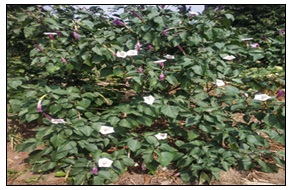
FIG. 1: WHOLE PLANT OF DATURA METEL L
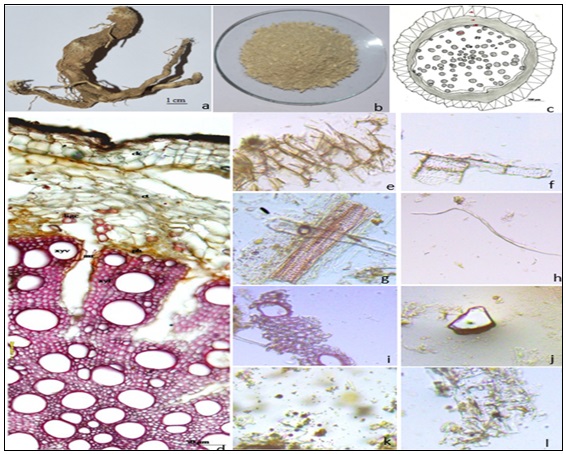
FIG. 2: A. ROOT OF D. METEL L., B. POWDER OF ROOT OF D. METEL L., C. SCHEMATIC OUTLINE DIAGRAM OF ROOT OF D. METEL L.,D. TS OF ROOT OF D. METEL L. AT 10X X 10X., E TO L POWDER MICROSCOPIC CHARACTERS (E. CORK IN SURFACE VIEW, F. PITTED PARENCHYMA, G. BORDERED PITTED VESSEL, H. NON- LIGNIFIED FIBER, I. FRAGMENT OF VASCULAR BUNDLE, J. PRISMATIC CRYSTAL OF CALCIUM OXALATE, K. COMPOUND STARCH GAINS AND L: OIL GLOBULES).
TABLE 1: HISTOCHEMICAL EVALUATION OF ROOT OF DM
| Test | Chemicals | Observation | Inference |
| Alkaloids | Dragendorff's reagent | Orange-red precipitate | + |
| Aleurone grains | Iodine solution | No yellowish brown to brown colour | - |
| Starch | Iodine solution | Blue colour | + |
| Mucilage | Ruthenium red | No pink colour | _ |
| Cuticle | |||
| Lignified cell | Phloroglucinol+HCl | Purple colour | + |
| Calcium oxalate crystal | HCl | dissolve | + |
| Calcium carbonate crystal | HCl | No effervescence | _ |
TABLE 2: PHYSICOCHEMICAL EVALUATION AND PH VALUE OF ROOT OF DATURA METEL L.
| Parameter | Value |
| LOD | Not more than 7.06% |
| TA | Not more than10.66% |
| AIA | Not more than1.02% |
| ASE | Not less than 2.46% |
| WSE | Not less than 9.48% |
| pH | 6.5283 to 6.5663 |
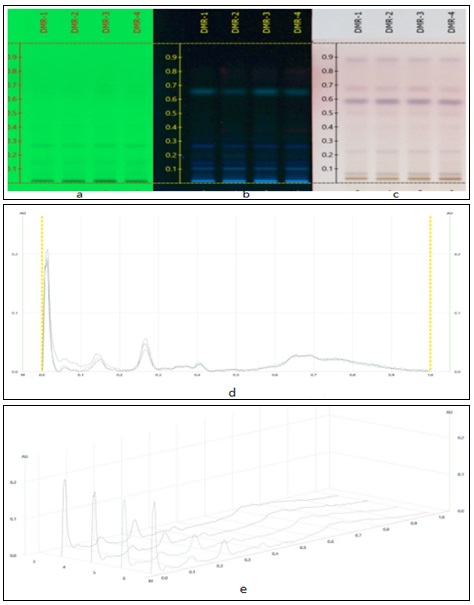
FIG. 3: HPTLC PLATES OF D. METEL L. (ROOT) UNDER UV 254 NM (A), UV 366 NM (B) AND VISIBLE AFTER DERIVATIZATION (C), 2D DENSITOGRAM (D) AND 3D DENSITOGRAM (E)
DISCUSSION: The present investigation establishes pharmacognostic and physicochemical quality standards for the root of DM. The root of this plant has received less attention than its leaves, flowers, and seeds despite its recognized ethnomedicinal importance. The macroscopic characters, including a cylindrical irregular root with a brown rough surface, fissured fracture, bitter taste, and characteristic odour, provide useful preliminary diagnostic features but similar gross morphological characteristics have been described for the roots of D. stramonium and D. inoxia, indicating that macroscopic characters alone are insufficient for authentication of root 31. Microscopic features shows a multilayered cork, parenchymatous cortex, amphicribal vascular bundles, lignified fibres and vessels, exarch protoxylem, developing medullary rays, and abundant lignified tissues. These anatomical features are consistent with the general root anatomy reported for Solanaceae and particularly for Datura species, where secondary growth results in well-developed lignified xylem surrounded by parenchymatous cortex. Similar anatomical observations have been reported in roots of Datura stramonium, including multilayered cork, lignified vessels and fibres, and abundant parenchymatous tissue. However, the present study additionally demonstrates the presence of conspicuous lignified cortical cells and developing medullary rays, which may serve as supplementary diagnostic characters for D. metel root.
In the present powder microscopy study, the presence of polygonal cork cells, lignified pitted parenchyma, bordered pitted vessels, elongated fibres, oil globules, compound starch grains, and prismatic calcium oxalate crystals constitutes a characteristic diagnostic profile. Approximately similar diagnostic characters have been described in powdered roots of D. stramonium and D. inoxia, particularly bordered vessels, calcium oxalate crystals and starch grains 32-33. Nevertheless, the simultaneous occurrence of lignified pitted parenchyma together with abundant oil globules observed in the present investigation has not been emphasized in previous pharmacognostic reports and therefore may provide additional value for identification of DM root. Histochemical analysis demonstrated positive reactions for alkaloids, lignin, starch and calcium oxalate, whereas mucilage, aleurone grains and calcium carbonate were absent. The localization of alkaloids agrees with phytochemical studies showing that Datura roots are important sites of tropane alkaloid biosynthesis.
The physicochemical constants generated in this investigation provide baseline quality control parameters for D. metel root. The relatively low acid-insoluble ash indicates minimal siliceous contamination, while the higher water-soluble extractive than alcohol-soluble extractive suggests that hydrophilic constituents constitute a substantial proportion of the root extract. Similar observations have been reported during pharmacognostic standardization of medicinal roots, where these parameters are considered reliable indicators of purity and quality since no official pharmacopoeial standards currently exist for D. metel root, the values reported here provide useful preliminary reference limits for future quality assessment.
HPTLC fingerprinting demonstrated reproducible chromatographic profiles with characteristic bands under UV 254 nm, UV 366 nm and after derivatization. The generated chromatographic fingerprint can serve as an identity profile for routine authentication. Future HPTLC methods employing authentic standards of atropine, hyoscyamine and scopolamine would strengthen chemical standardization and facilitate quantitative quality control.
Compared with other species of the genus, particularly D. stramonium, D. inoxia and D. ferox, the overall anatomical organization of the root is highly conserved, reflecting their close taxonomic relationship. Consequently, identification based solely on gross morphology or individual microscopic characters may be unreliable. Instead, a combination of macroscopic, anatomical, powder microscopic, histochemical, physicochemical and chromatographic parameters, as presented in this study, provides a more robust approach for authenticating DM root and detecting substitution or adulteration.
CONCLUSION: The macroscopic, microscopic, powder drug analysis, histochemical analysis and physicochemical analysis revealed specific histological arrangements and physicochemical standards and HPTLC play important role in identification of genuine sample of plants, detection of adulteration and substitution. Physicochemical parameter data helps in evaluation of quality aspects and safety aspects in preliminary form.
ACKNOWLEDGEMENTS: Authors are thankful to Director general CCRAS, Ministry of AYUSH for financial support to the IMR Project.
CONFLICT OF INTEREST: Nil
REFERENCES:
- Sharma M, Dhaliwal I, Rana K, Delta AK and Kaushik P: Phytochemistry, pharmacology, and toxicology of Datura species—A review. Antioxidants 2021; 10(8): 1291.
- Ajungla L, Patil PP, Barmukh RB and Nikam TD: Influence of biotic and abiotic elicitors on accumulation of hyoscyamine and scopolamine in root cultures of Datura metel L. Indian Journal of Biotechnology 2009.
- Saxton JE: The Alkaloids. The Chemical Society 1975; 5: 69-70.
- Yang BY, Luo YM, Liu Y, Yin X, Zhou YY and Kuang HX: New lignans from the roots of Datura metel L. Phytochemistry Letters 2018; 28: 8-12.
- Yang BY, Yang CL, Liu Y and Kuang HX: Chemical constituents from roots of Datura metel. Zhongguo Zhong yao za zhi= Zhongguo Zhongyao Zazhi= China Journal of Chinese Materia Medica 2018; 43(8): 1654-1661.
- Islam T, Ara I, Islam T, Sah PK, de Almeida RS, Matias EF, Ramalho CL, Coutinho HD and Islam MT: Ethnobotanical uses and phytochemical, biological, and toxicological profiles of Datura metel L.: a review. Current Research in Toxicology 2023; 4: 100106.
- Alam W, Khan H, Khan SA, Nazir S and Akkol EK: Datura metel: A review on chemical constituents, traditional uses and pharmacological activities. Current Pharmaceutical Design 2021; 27(22): 2545-57.
- Mangal AK, Tomer R, Jindal H, Prasad SB, Singh H, Sharma BS, Srikanth N and Dhiman KS: Development and standardisation of Laghu Sudarshan Churna–An Ayurvedic polyherbal formulation. Indian Journal of Traditional Knowledge 2022; 21(1): 106-112.
- Kumari TJ, Pratap GP, Prasad SB, Murthy P & Prasad GP: Standardization of Balamula churna (Sida cordifolia L. root powder). International Journal of Current Pharmaceutical Research 2019; 27-30.
- Mangal AK, Tomer R, Jindal H, Dahiya J, Prasad SB, Singh H, Sharma BS and Srikanth N: Development of Quality Control Parameters for Classical Ayurvedic Formulation: Vyoshadi Churna. Journal of Ayurveda 2023; 17(1): 38-44.
- Mangal AK, Tomer R, Jindal H, Prasad SB, Sharma H, Sharma BS, Srikanth N and Dhiman KS: Development and standardization of Chaturbhadra Kvath Churna: An ayurvedic formulation. Journal of Drug Research in Ayurvedic Sciences 2019; 4(4): 192-8.
- Sharma M and Prasad SB: Standardisation of Guazuma tomentosa leaf. Int J Pharmacogn Phytochem Res 2014; 6(4): 1010-4.
- Nirawane RB, Prasad SB, Kumar S, Gurav AM, Rao G, Prasad GP and Mangal AK: Pharmacognostic Evaluation of Root of Albizia lebbeck (Linn.) Benth. International Journal of Pharmacognosy and Phytochemical Research 2018; 10(5): 229-34.
- Ravi Kumar: Microscopy, Working and Types. Asian Journal of Pharmacy and Technology 2021; 11(3): 245-8.
- Ramasubramaniaraja R: Pharmacognostical Phytochemical Including GC-MS Investigation of Ethanolic Leaf Extracts of Abutilon indicum (Linn). Asian J Pharm Ana 2011; 1(4): 88-92.
- Dibyajyoti Saha and Swati Paul: Pharmacognostic Studies of Aerial Part of Methanolic Extract of Alpinia conchigera Griff. Asian J Pharm Ana 2012; 2(2): 46-48.
- Saha D, Pahari SK, Maity T, Sur D, Kayal S, Ghindora GL and Dhirehe UK: Pharmacognostic Studies of Leaf of Lippia alba. Asian J Pharm Res 2011; 1(1): 17-18.
- Batra Neha, Jain Honey, Bairwa Ranjan and Bachwani Mukesh: Pharmacognostical and preliminary phytochemical investigation of Acorus calamus linn. Asian J Pharm Res 2012; 2(1): 39-42.
- Thamizharasi Suresh, Shankari Vellaisamy, Parvatha Raja Kumaran VS and Chetan Ashok: Pharmacognostical and Phytochemical Screening of Leaves of Raphanus sativus Linn. Asian Journal of Pharmaceutical Research 2024; 14(1): 25-2.
- Swati Paul and Dibyajyoti Saha: Pharmacognostic Studies of Aerial Part of Pouzolzia zeylanica (L.). Asian J Pharm Tech 2012; 2(4): 141-142.
- Rukhsana A. Rub, Asma Mukadam, Javed Pinjari, Ajaz Nathani and Aaisha Sagri: Pharmacognostic and Phytochemical Evaluation of Quirivelia frutescens (Apocynaceae). Asian J Research Chem 2009; 2(4): 509-512.
- Prasad SB, Murkute A, Prasad GP, Gurav AM, Mangal AK, Srikanth N and Acharya R: Quality Aspects of Stem of Cryptolepis dubia (Burm. F.) MR Almeida on the basis of Pharmacognostic Physicochemical and Chromatographic Evaluation. Research Journal of Pharmacy and Technology 2025; 18(7): 3324-9.
- Prasad SB and Sharma A: Standardisation of convolvulus pluricaulis choisy herbs collected from Jalandhar, Punjab. Int. J. Pharmacogn. Phytochem. Res 2016; 8: 1412-6.
- Prasad SB, Gurav AM and Prasad GP: Pharmacognostic and Preliminary Phytochemical Evaluation of Leaf of Syzygium cumini (L.) Skeels. International Journal of Ayurvedic Medicine 12(3): 684-8.
- Shyam Baboo Prasad, Snehal Gaikwad, Shiddamallayya Nagayya, Arun M. Gurav, Goli P Prasad and Anupam K: Mangal, Venkateshwarlu Bandi, Narayanam Srikanth. Pharmacognostic and Preliminary Phytochemical Evaluation of root of Coptis teeta Wall. Research Journal of Pharmacy and Technology 2024; 17(5): 1933-7.
- Shyam Baboo Prasad, Snehal Gaikwad, Arun M and Gurav Anupam K: Mangal Shiddamallayya Nagayya Venkateshwarlu Bandi Narayanam Srikanth Rabinarayan Acharya. Pharmacognostic and Phytochemical Evaluation of Staminate Flower of Cocos nucifera L. Journal of Natural Remedies 2024; 24(5): 1117-1124.
- Pratap GP, Husain MK, Prasad SB, Gurav AM, Alam M, Prasad GP and Munshi YI: Phyto-Pharmacognostical Standardization of Three Morpho-Variants of Cissus quadrangularis L. Pharmacognosy Research 2024; 16(3).
- Gandhi Y, Kumar V, Singh G, Prasad SB, Mishra SK, Soni H, Rawat H, Singh S, Charde V, Gupta A and Dhanjal DS: Chemoprofiling and medicinal potential of underutilized leaves of Cyperus scariosus. Scientific Reports 2024; 14(1): 7263.
- Gandhi MY, Prasad SB, Kumar V, Soni H, Rawat H, Mishra SK, Grewal J, Singh S, Charde V, Gupta A and Jha SK: Quantification of phytochemicals and metal ions as well as the determination of volatile compounds, antioxidant, antimicrobial and antacid activities of the Mimosa pudica L. Leaf: Exploration of Neglected and Under‐Utilized Part. Chemistry & Biodiversity 2023; 20(10): 202301049.
- Gandhi Y, Rawat H, Kumar V, Thakur A, Mishra SK, Charde V, Soni H, Singh G, Tandon S, Kumar R and Shakya SK: Identification of two kinds of Colchicum corms by DNA barcoding, physicochemical, chromatographic and chemometric analyses along with pharmacognostic parameters. Microchemical Journal 2023; 195: 109399.
- Dahiya J, Mangal AK, Bolleddu R, Kumar D, Abdullah S, Prasad SB, Dutta S, Mall S, Hazra K and Babu G: HPTLC based marker and fingerprint analysis coupled with multivariate analysis of different parts of Cyanthillium cinereum from Different Geographical Locations. Chromatographia 2024; 1-2.
- Sharma H, Mishra SK, Khan R, Prasad SB, Narasimhaji CV, Srikanth N and Acharya R: A validated phytochemical marker based HPTLC method for the segregation of Bauhinia vahlii Wight and Arn. from geologically different samples of Indian zones. JPC–Journal of Planar Chromatography–Modern TLC 2024; 37(4): 331-43.
- Sangekar SN and Devarkar VD: Pharmacognostical studies in D. inoxia Mill. Biosci Discov 2017; 8: 468-73.
- Naeem Z, Ahmad MS, Hameed M and Rasul F: Physiological and anatomical modifications of Datura stramonium L. roots collected from dry environments. Pak J Bot 2023; 55(4): 1429-38.
- Gulaguli R, Betageri S, Patgar VG and Kotresha K: Anatomical studies (Stem & Ovary) of Genus Datura L. (Solanaceae) in Karnataka, India. Journal of Plant Biota 2025; 4(1): 77-81.
How to cite this article:
Prasad SB, Murkute A, Prasad GP, Mangal AK, Babu G, Nagayya S, Natrunai G and Srikanth N: Pharmacognostic and phytochemical evaluation of root of Datura metel L. Int J Pharmacognosy 2026; 13(10): 1051-57. doi link: http://dx.doi.org/10.13040/IJPSR.0975-8232.IJP.13(10).1051-57.
This Journal licensed under a Creative Commons Attribution-Non-commercial-Share Alike 3.0 Unported License.
Article Information
8
1051-1057
1792 KB
7
English
IJP
Shyam Baboo Prasad *, Akshada Murkute, Goli Penchala Prasad, Anupam K. Mangal, G. Babu, Shiddamallayya Nagayya, G. Natrunai and Narayanam Srikanth
Regional Ayurveda Research Institute, Pune, Maharashtra, India.
b.shyam2@gmail.com
08 September 2026
29 September 2026
30 September 2026
10.13040/IJPSR.0975-8232.IJP.13(10).1051-57
01 October 2026
 Download