


HERBAL MODULATION OF HYPERGLYCEMIA VIA AMPK ACTIVATION
HTML Full TextHERBAL MODULATION OF HYPERGLYCEMIA VIA AMPK ACTIVATION
Saiyad Bastaminejad and Esmaeil Ebrahimi *
Department of Biology, Faculty of Basic Sciences, Payame Noor University, Ilam, Iran.
ABSTRACT: Type 2 diabetes mellitus (T2DM) is a chronic metabolic disorder characterized by persistent hyperglycemia arising from insulin resistance and progressive β-cell dysfunction. Adenosine monophosphate-activated protein kinase (AMPK), a heterotrimeric serine/threonine kinase and central cellular energy sensor, has emerged as an attractive pharmacological target because its activation enhances peripheral glucose uptake, suppresses hepatic gluconeogenesis, promotes fatty-acid oxidation, and improves insulin sensitivity. A growing body of phytochemical research indicates that numerous medicinal plants and their bioactive constituents lower blood glucose, at least in part, by engaging this pathway. This review synthesizes current evidence on herbal AMPK activators relevant to hyperglycemia, and a broader catalog of emerging phenolic and terpenoid activators. Mechanistic data from cell-based, animal, and clinical studies are summarized, molecular docking and structure–activity findings are reviewed, and translational challenges relating to bioavailability, nanoformulation, extract standardization, polyherbal synergy, herb–drug interactions, and mechanistic specificity are discussed in depth. Herbal AMPK activators represent a promising, multi-target complement to conventional antidiabetic therapy, warranting rigorously designed clinical trials to establish optimal dosing, efficacy, and long-term safety.
Keywords: AMP-activated protein kinase, hyperglycemia, Herbal medicine, Berberine, Type 2 diabetes, Phytochemicals, Nanoformulation, Polyherbal synergy
INTRODUCTION: Diabetes mellitus remains one of the most significant global public-health challenges, with type 2 diabetes accounting for approximately 90% of all diagnosed cases and its prevalence continuing to rise in association with obesity, sedentary lifestyles, and an ageing population 1.
Chronic hyperglycemia, the biochemical hallmark of the disease, arises from a combination of impaired insulin secretion and peripheral insulin resistance and drives the microvascular and macrovascular complications that account for much of diabetes-related morbidity and mortality 1, 2.
Although several classes of oral hypoglycemic drugs are available, many are limited by adverse effects, secondary failure, cost, or contraindications in specific patient populations, motivating continued interest in plant-derived alternatives and adjuncts 3. Among the intracellular targets exploited by both pharmaceutical and herbal antidiabetic agents, AMP-activated protein kinase (AMPK) occupies a central position. AMPK functions as an evolutionarily conserved cellular fuel gauge that is switched on when the AMP/ATP and ADP/ATP ratios rise, signaling energy deficit 1, 4, 5. Once activated, AMPK reprograms cellular metabolism to restore energy balance: it increases glucose uptake and glycolysis, stimulates mitochondrial biogenesis and fatty-acid oxidation, and inhibits energy-consuming anabolic pathways such as gluconeogenesis, lipogenesis, and cholesterol synthesis 4. Because these actions collectively lower blood glucose and improve insulin sensitivity, AMPK is already the validated target of the widely used first-line antidiabetic drug metformin, and its pharmacological activation is considered a rational strategy for managing hyperglycemia 1, 6, 7.
Interest in herbal AMPK activators has grown substantially over the past two decades, driven by ethnopharmacological precedent, favorable safety profiles relative to some synthetic agents, and the multi-target pharmacology characteristic of plant extracts 8. This growth has been accompanied by an expansion of the phytochemical landscape under investigation: whereas early work concentrated almost exclusively on berberine and a small number of well-known botanicals, the past decade has seen mechanistic and, increasingly, clinical characterization of a much wider range of species, from polysaccharide-rich adaptogens such as Astragalus membranaceus to classical Ayurvedic anti-diabetic herbs such as Gymnema sylvestre and Trigonella foenum-graecum 9. In parallel, methodological advances in computational pharmacology particularly molecular docking and pharmacokinetic-prediction tools have begun to clarify how structurally diverse phytochemicals interact with the AMPK heterotrimer at the atomic level, while pharmaceutical-sciences research has focused on nanoformulation and polyherbal strategies to overcome the poor oral bioavailability that limits many of these compounds clinically 10.
This review summarizes current mechanistic and clinical evidence on the principal herbal AMPK activators relevant to hyperglycemia, extends the survey to include a broader panel of emerging botanicals, reviews computational structure–activity evidence, discusses formulation strategies intended to improve translational potential, examines the strength and limitations of the underlying evidence base, and considers herb-drug interaction risks and other translational barriers to clinical adoption.
AMPK; Molecular Structure, Activation, and Role in Glucose Homeostasis: AMPK is a heterotrimeric enzyme composed of a catalytic α-subunit and regulatory β- and γ-subunits 1. In mammals, each subunit exists as multiple isoforms (α1, α2; β1, β2; γ1, γ2, γ3), giving rise to up to twelve possible heterotrimeric combinations with distinct tissue distributions and, in some cases, distinct pharmacological sensitivities; the α2β2γ1 and α1β2γ1 complexes, for example, predominate in skeletal muscle and liver, respectively, and this heterogeneity is increasingly recognized as a determinant of why certain phytochemicals show tissue-selective metabolic effects. Under conditions of cellular energy stress, AMP and ADP bind to the γ-subunit, inducing a conformational change that promotes phosphorylation of threonine-172 on the α-subunit by upstream kinases, principally liver kinase B1 (LKB1) and, in a calcium-dependent manner, calcium/calmodulin-dependent protein kinase kinase-β (CaMKKβ) 1. This phosphorylation event, together with allosteric activation by AMP and protection of the phosphorylated state from cellular phosphatases such as protein phosphatase 2A (PP2A) and PP2C, constitutes the canonical route of AMPK activation 1, 10.
Once activated, AMPK exerts wide-ranging effects on glucose and lipid metabolism. In skeletal muscle, AMPK promotes translocation of the glucose transporter GLUT4 to the plasma membrane via phosphorylation of the Rab-GAP protein TBC1D4/AS160, enhancing insulin-independent glucose uptake 1. In the liver, AMPK suppresses the transcription of the rate-limiting gluconeogenic enzymes phosphoenolpyruvate carboxykinase (PEPCK) and glucose-6-phosphatase (G6Pase), in part through phosphorylation of the CRTC2 transcriptional coactivator and consequent disruption of the CRTC2–CREB complex, thereby reducing hepatic glucose output, while simultaneously inhibiting acetyl-CoA carboxylase (ACC) to favor fatty-acid oxidation over lipogenesis 1, 4. AMPK activation also curtails β-cell apoptosis, mitigates oxidative stress and inflammation, and interacts reciprocally with the mammalian target of rapamycin (mTOR) and insulin-signaling pathways, including PI3K/Akt, to preserve cellular energy homeostasis 1, 11.
Natural AMPK activators are broadly classified as direct activators, which bind the enzyme complex itself typically at an allosteric drug-and-metabolite (ADaM) site formed at the interface of the α and β subunits, the same site exploited by synthetic activators such as A-769662 and salicylate or indirect activators, which raise the cellular AMP/ATP ratio, commonly through mild inhibition of mitochondrial respiratory complex I or ATP synthase, thereby triggering LKB1- or CaMKKβ-mediated phosphorylation 12. Many herbal constituents discussed below, including berberine, resveratrol, and curcumin, are thought to act predominantly through this indirect, mitochondria-linked mechanism 1, 11, whereas a smaller number of compounds, most notably the Gynostemma-derived damulins, appear to engage AMPK more directly. This mechanistic dichotomy has practical relevance for drug development, since indirect activators risk broader off-target mitochondrial toxicity at high concentrations, whereas direct ADaM-site activators may offer greater selectivity, an issue increasingly explored through molecular docking, as discussed later in this review.
Herbal AMPK Activators in the Management of Hyperglycemia:
Coptis chinensis, Berberis vulgaris: Berberine is an isoquinoline alkaloid isolated from Coptis chinensis (Huanglian) and related Berberis species that has been used historically in Chinese and Ayurvedic medicine 3. Mechanistically, berberine mildly inhibits mitochondrial respiratory complex I, raising the intracellular AMP/ATP ratio and triggering AMPK phosphorylation; this action is accompanied by a marked stimulation of glycolysis and lactate production in hepatocytes and myotubes 13. Downstream, AMPK activation by berberine suppresses hepatic gluconeogenesis via the LKB1–AMPK–TORC2 axis, with corresponding reductions in PEPCK and glucose-6-phosphatase expression in diabetic rat liver 14.
The role of AMPK in berberine’s glucose-lowering action is, however, more complex than initially assumed. Pharmacological or genetic blockade of AMPK (using Compound C, AMPKα-directed siRNA, or dominant-negative AMPKα constructs) does not fully abolish berberine-induced glucose uptake in hepatocytes and myotubes, indicating that AMPK-independent stimulation of glycolysis also contributes to its antihyperglycemic effect 15. Similarly, berberine’s suppression of hepatic glucagon signaling and gluconeogenesis in diabetic mice has been shown to proceed, at least in part, independently of AMPK 16. AMPK activity in response to berberine is also bidirectionally regulated by ambient glucose concentration, being activated under moderate-glucose conditions but suppressed under conditions that would otherwise activate AMPK through glucose withdrawal 17. These findings underscore that berberine, like many phytochemicals, engages multiple, only partially overlapping pathways rather than a single AMPK-centered mechanism.
Clinically, berberine is among the most extensively studied herbal antihyperglycemic agents. A systematic review and meta-analysis of 46 randomized controlled trials reported that berberine, used alone or as an adjunct to standard therapy, significantly reduced glycated hemoglobin (HbA1c), fasting plasma glucose, and 2-hour postprandial glucose, alongside improvements in insulin resistance indices and lipid profile 17. These effects appear comparable in magnitude to some conventional oral hypoglycemic agents in short- to medium-term trials, although trial quality, geographic representativeness, and long-term safety data remain limited 3, 17.
Gynostemma pentaphyllum: Gynostemma pentaphyllum, known as “Southern Ginseng” or jiaogulan, is a Cucurbitaceae vine used traditionally throughout East and Southeast Asia. Bioassay-guided fractionation of its ethanolic extract identified two novel dammarane-type saponins, damulin A and damulin B, as potent direct activators of AMPK in cultured L6 myotubes, where they increased glucose uptake, GLUT4 translocation, and fatty-acid β-oxidation 18. Heat-processing of the raw extract increases damulin content and correspondingly enhances AMPK-dependent glucose uptake and fat oxidation in muscle cells, with associated anti-obesity effects reported in animal models.
Gypenoside-rich extracts of G. pentaphyllum reduce fasting glucose and improve glucose tolerance and insulin resistance in models of type 2 diabetes through hepatic AMPK phosphorylation and downregulation of PEPCK and glucose-6-phosphatase, and reduce hepatic glucose output in the Goto–Kakizaki rat model of spontaneous type 2 diabetes. A randomized, placebo-controlled trial in drug-naïve patients with type 2 diabetes similarly reported improvements in HbA1c and fasting plasma glucose following G. pentaphyllum extract supplementation, and a crossover trial in healthy men demonstrated that four weeks of supplementation increased skeletal-muscle AMPK Thr172 phosphorylation following exercise, alongside reductions in blood glucose and leptin. Collectively, these findings position G. pentaphyllum among the more mechanistically well-characterized herbal AMPK activators, with damulins A and B identified as its principal active constituents 18.
Momordica charantia: Momordica charantia, widely consumed as a vegetable and used traditionally for diabetes across Asia, Africa, and the Caribbean, contains cucurbitane-type triterpenoids including momordicosides Q, R, S, and T and karaviloside XI that stimulate GLUT4 translocation and glucose uptake in L6 myotubes and 3T3-L1 adipocytes via activation of AMPK, and enhance fatty-acid oxidation and glucose disposal in both insulin-sensitive and insulin-resistant mice 19. Downstream, AMPK activation by bitter melon constituents promotes glycogen synthase activity and glycogen synthesis while inhibiting glucose-6-phosphatase, thereby reducing hepatic glucose output 19. A 2025 grade-adherent meta-analysis of 25 randomized controlled trials (34 sub-studies) in patients with prediabetes or type 2 diabetes found that M. charantia supplementation significantly reduced fasting blood glucose and HbA1c relative to control, supporting a modest but consistent clinical glucose-lowering effect that parallels its AMPK-linked preclinical mechanism 20.
Curcuma longa: Curcumin, the principal curcuminoid of turmeric (Curcuma longa), has long been used in Ayurvedic and traditional Chinese medicine and has been studied extensively for its antidiabetic and anti-inflammatory properties 21. In skeletal muscle, curcumin improves insulin resistance via the LKB1–AMPK pathway and enhances GLUT4-mediated glucose uptake, while in the liver it suppresses gluconeogenic enzyme expression (PEPCK, glucose-6-phosphatase) and stimulates sirtuin-1 (SIRT1) signaling 21, 22. Curcumin additionally activates peroxisome proliferator-activated receptor-γ (PPAR-γ) and inhibits nuclear factor-κB (NF-κB)-driven inflammation, actions that complement its AMPK-dependent effects on hepatic glucose output and are thought to converge on improved glycemic control across multiple rodent models of diabetes and obesity 21, 23. Clinical evidence, while still limited by curcumin’s poor oral bioavailability, includes randomized trials in which curcumin supplementation alone or combined with bioavailability enhancers such as piperine improved fasting glucose, HbA1c, and lipid parameters in patients with prediabetes and type 2 diabetes 21.
Cinnamomum spp.: Cinnamon bark extract and its principal bioactive constituent, cinnamaldehyde, stimulate LKB1-dependent phosphorylation of AMPK and acetyl-CoA carboxylase in 3T3-L1 adipocytes and C2C12 myotubes, an effect abolished by pharmacological AMPK inhibition or LKB1 knockdown, confirming a causal role for this pathway in cinnamon-induced glucose uptake 24. In-vivo, cinnamon extract improves oral glucose tolerance in type 2 diabetic rodents through enhanced GLUT4 translocation, and notably, insulin itself appears to antagonize AMPK activation in adipocytes, suggesting that cinnamon’s insulin-independent, AMPK-mediated pathway may be of particular relevance in insulin-resistant states 24. These findings provide a coherent mechanistic basis for the modest but reproducible glucose-lowering effects reported for cinnamon supplementation in clinical studies of type 2 diabetes and prediabetes.
Gymnema sylvestre: Gymnema sylvestre, an Ayurvedic climbing shrub whose Hindi name gurmar translates as “sugar destroyer,” has a long tradition of use for hyperglycemia across South Asia. Its principal bioactive constituent, gymnemic acid, has been shown in streptozotocin- and high-fat-diet-induced type 2 diabetic rats to reduce fasting blood glucose by approximately 27% and to lower circulating insulin, effects associated with coordinated activation of hepatic PI3K/Akt and AMPK signaling, attenuation of endoplasmic-reticulum stress markers, and improved hepatic insulin receptor substrate phosphorylation 25. Beyond this hepatic AMPK-linked mechanism, gymnemic acid and related triterpenoid saponins in G. sylvestre also act at the level of the intestinal brush border, where they are thought to inhibit glucose absorption and support pancreatic β-cell function, giving the plant a multi-site pharmacological profile that extends beyond AMPK alone. Complementary work in alloxan-induced hyperglycemic rats has shown that G. sylvestre supplementation restores pancreatic insulin gene transcription, suggesting an additional insulinotropic component to its antihyperglycemic activity that operates in parallel with, rather than solely through, AMPK-dependent glucose disposal.
Astragalus membranaceus: Astragalus membranaceus (Huangqi) is a leguminous root widely used in traditional Chinese medicine as a qi tonic, and its principal water-soluble constituent, Astragalus polysaccharide (APS), has attracted considerable interest as an AMPK-linked antihyperglycemic agent. In cultured L6 myotubes, APS stimulates glucose uptake through activation of the AMP-AMPK axis and subsequent phosphorylation of the Rab-GTPase-activating protein AS160/TBC1D4, the same downstream node engaged by insulin and exercise to drive GLUT4 translocation, indicating that APS taps directly into the canonical AMPK-GLUT4 trafficking pathway 26.
In streptozotocin-induced diabetic rats, chronic APS administration alleviates glucose toxicity, increases hepatic glycogen synthesis, and enhances skeletal-muscle glucose translocation, with these whole-animal benefits attributed, at least in part, to sustained AMPK activation in liver and muscle 27. Because APS is a high-molecular-weight polysaccharide rather than a small lipophilic molecule, its pharmacokinetic behavior including absorption, tissue distribution, and metabolism by gut microbiota differs substantially from that of the alkaloid and polyphenol activators discussed elsewhere in this review, and this distinction is increasingly recognized as relevant to the design of APS-based formulations and to interpretation of its systemic versus local (e.g., intestinal microbiome-mediated) mechanisms of action.
Morus alba: Mulberry (Morus alba) leaves have been used in East Asian traditional medicine to manage hyperglycemia, and their principal iminosugar constituent, 1-deoxynojirimycin (1-DNJ), is a well-characterized α-glucosidase inhibitor that blunts postprandial glucose excursions by slowing intestinal carbohydrate digestion. Beyond this carbohydrate-absorption mechanism, flavonoid-rich fractions of mulberry leaf, distinct from the 1-DNJ-containing fraction, have been shown to improve skeletal-muscle mitochondrial function in type 2 diabetic animal models through activation of AMPK, with associated increases in mitochondrial biogenesis markers and fatty-acid oxidative capacity 28. Mulberry leaf extract additionally stimulates glucose disposal in skeletal-muscle cells via combined activation of the PI3K/Akt and AMPK pathways, again illustrating the pattern, recurrent throughout this review, whereby a single botanical engages AMPK alongside other convergent insulin-signaling nodes. In a randomized clinical trial, mulberry leaf extract standardized for 1-DNJ content improved postprandial glucose control in patients with impaired glucose tolerance, supporting translational relevance for this traditionally used botanical, although the relative clinical contribution of its AMPK-dependent flavonoid component versus its α-glucosidase-inhibitory iminosugar component has not yet been formally dissected 29.
Rhodiola rosea: Rhodiola rosea, an adaptogenic herb native to arctic and alpine regions of Europe and Asia, contains the phenylpropanoid glycoside salidroside as its principal bioactive marker compound. Salidroside stimulates glucose uptake in cultured skeletal-muscle cells through direct activation of AMPK, an effect associated with enhanced GLUT4 translocation and improved insulin sensitivity in-vitro 30. In diet-induced insulin-resistant rodent models, salidroside administration substantially lowers blood glucose and serum insulin concentrations and ameliorates dyslipidaemia, with pharmacological AMPK inhibition attenuating these benefits and confirming a mechanistic dependence on the pathway. Salidroside has additionally been reported to protect pancreatic β-cells from oxidative and lipotoxic stress, improving β-cell survival in models of glucolipotoxicity, an action that together with its AMPK-dependent peripheral effects positions Rhodiola rosea as a dual-acting botanical candidate addressing both insulin resistance and progressive β-cell failure, the two central pathophysiological defects of type 2 diabetes 31. Preliminary human data suggest that Rhodiola supplementation can lower fasting glucose and favorably modulate gut microbial composition, although dedicated randomized trials specifically evaluating glycemic endpoints remain comparatively sparse relative to berberine or Gynostemma.
Nigella sativa: Nigella sativa, commonly known as black seed or black cumin, is used across the Middle East, North Africa, and South Asia both as a spice and as a traditional remedy for a wide range of metabolic and inflammatory conditions. Its principal bioactive quinone, thymoquinone, has been reported to engage the AMPK pathway in several preclinical models of diabetes, contributing to improved glucose tolerance through enhanced peripheral glucose uptake and suppression of hepatic gluconeogenic gene expression 32. Mechanistic reviews synthesizing this literature note that N. sativa’s antidiabetic activity is not attributable to AMPK activation alone but reflects a convergence of antioxidant, anti-inflammatory, and insulin-sensitizing actions, including modulation of PPAR-γ and attenuation of NF-κB-driven cytokine production in adipose and hepatic tissue, actions that together support its long-standing use as an adjuvant therapy in diabetes management 33. Clinical trials and meta-analyses of N. sativa seed or oil supplementation in patients with type 2 diabetes have generally reported significant, if modest, reductions in fasting blood glucose, HbA1c, and markers of insulin resistance, consistent with though not definitively proving a contribution from AMPK-linked mechanisms identified in preclinical work.
Trigonella foenum-graecum: Fenugreek seeds, a staple culinary and medicinal plant across South Asia and the Middle East, contain a chemically diverse set of antidiabetic constituents, including the alkaloid trigonelline, the flavonoid isoorientin, and the steroidal saponin diosgenin 34, 35.
Isoorientin has been shown to increase glucose uptake in cultured cells by promoting phosphorylation of both Akt and AMPK, thereby enhancing GLUT4-mediated glucose transport through parallel activation of insulin-dependent and insulin-independent signaling arms 35, 36. Trigonelline itself lowers blood glucose in diabetic animal models and is thought to act partly by improving glucose transport and vesicular trafficking in peripheral tissues, while diosgenin promotes adipocyte differentiation and exerts anti-inflammatory effects in adipose tissue that indirectly support improved glucose handling 1, 37, 38.
Because fenugreek extracts typically contain all three of these constituents alongside soluble fiber that itself delays carbohydrate absorption, the antihyperglycemic effect observed in clinical trials of fenugreek seed powder or extract which has repeatedly shown reductions in postprandial and fasting glucose in patients with type 2 diabetes most plausibly reflects a composite of AMPK-linked glucose transport enhancement, fiber-mediated absorption delay, and insulin-sensitizing adipose effects rather than a single dominant mechanism 39, 40.
Salacia reticulata: Salacia reticulata, known in Sri Lanka as kothala himbutu, is a traditional Ayurvedic remedy whose root and stem extracts have been used for centuries to manage diabetes 41, 42. Contemporary mechanistic work indicates that Salacia reticulata extract improves insulin sensitivity and glucose metabolism in models of type 2 diabetes through activation of hepatic AMPK, coupled with repression of sterol regulatory element-binding protein 1c (SREBP-1c), an action that simultaneously curbs hepatic lipogenesis and improves glycemic control, positioning the extract as exerting combined antihyperglycemic and antihyperlipidemic effects through a shared AMPK-centered node 43. Salacia species are additionally recognized, independently of AMPK, as sources of salacinol and related sulfonium-sulfate compounds that potently inhibit intestinal α-glucosidase, again illustrating the recurring theme that clinically observed glucose-lowering effects of a whole plant extract typically integrate AMPK-dependent and AMPK-independent actions 44.
Systematic reviews of the available human evidence describe consistent improvements in insulin resistance and glycemic parameters with Salacia reticulata supplementation, while cautioning that the evidence base remains smaller and less methodologically rigorous than that available for berberine or Gynostemma pentaphyllum 42.
Other Emerging Phytochemical AMPK Activators: As it is shown in Table 1, there are some plants that activate AMPK signaling so that it ends up normalizing blood glucose. Interestingly, we can mention other AMPK activators:
Resveratrol, a stilbene polyphenol found in grapes, red wine, and Polygonum cuspidatum, activates AMPK in hepatocytes through a mechanism involving downregulation of protein phosphatase 2A (PP2A) and activation of CaMKKβ; pharmacological AMPK inhibition abolishes resveratrol’s beneficial effects on hepatic glucose uptake and glycogen synthesis, confirming AMPK as the principal downstream effector in this model 45. In mice fed a high-fat diet, resveratrol treatment ameliorates diet-induced abnormalities in hepatic glucose metabolism, increases glucose absorption and glycogen synthesis, and improves insulin resistance through this AMPK-dependent route 45. In clinical studies, resveratrol supplementation (150 mg/day for 30 days) in obese individuals improved glucose homeostasis and insulin sensitivity in association with activation of AMPK, PGC-1α, and SIRT1 in skeletal muscle, mirroring some of the metabolic benefits of caloric restriction 1.
Beyond the compounds detailed above, a substantial and growing catalogue of phenolic, flavonoid, and terpenoid phytochemicals has been reported to activate AMPK in preclinical models of hyperglycemia 1. Eugenol, from clove (Eugenia caryophyllata), enhances AMPK phosphorylation via CaMKK and suppresses the hepatic CRTC2–CREB transcriptional complex, reducing expression of gluconeogenic enzymes 1, 46. [6]-Gingerol, from ginger (Zingiber officinale), activates AMPK, promotes GLUT4 translocation, and protects pancreatic β-cells from oxidative stress in diabetic mouse models 1, 47, 48. Chlorogenic acid, abundant in coffee, stimulates glucose transport in skeletal muscle through AMPK activation, an effect demonstrated in both L6 myotubes and isolated soleus muscle preparations, and downregulates hepatic glucose-6-phosphatase expression 49; green coffee extract, which is rich in chlorogenic acid, has correspondingly shown glucose-lowering effects in human trials 1, 50.
Epigallocatechin-3-gallate (EGCG), the principal catechin of green tea (Camellia sinensis), activates the PI3K/Akt and AMPK pathways to enhance glucose uptake; a meta-analysis of seventeen clinical trials involving 1,133 participants found that green tea intake significantly reduced HbA1c and fasting glucose 1, 51, 52.
Quercetin enhances AMPK phosphorylation, inhibits glucose-6-phosphatase, and alleviates insulin resistance across multiple preclinical models mechanistic work in skeletal muscle indicates that quercetin engages a signaling cascade closely paralleling that of metformin, lending pharmacological plausibility to its candidacy as a lead antidiabetic compound 53 while malonyl-ginsenosides from Panax ginseng improve insulin resistance and glucose tolerance via coordinated activation of the PI3K/AKT/AMPK/ACC/GLUT4 axis in liver and skeletal muscle 1, 54. The breadth of this evidence base illustrates that AMPK activation is a convergent mechanism shared across chemically diverse plant secondary metabolites, though the depth of mechanistic and clinical characterization varies considerably between compounds.
TABLE 1: SUMMARY OF SELECTED HERBAL AMPK ACTIVATORS RELEVANT TO HYPERGLYCEMIA
| Plant Bioactive Compound(s) | Experimental Model(s) | AMPK-Related Mechanism | Metabolic Effects | Ref. |
| Coptis chinensis
Berberisvulgaris Berberine |
HepG2 cells; L6/C2C12 myotubes; STZ- and HFD-induced diabetic rodents; RCTs in T2DM patients | Mild inhibition of mitochondrial complex I leading to increased AMP/ATP ratio and AMPK phosphorylation; activation of LKB1–AMPK–TORC2 axis (partly AMPK-independent) | Decreased hepatic gluconeogenesis (PEPCK, G6Pase); increased glycolysis; reduction in HbA1c (~0.7 percentage points in meta-analysis) | 13–17,55 |
| Gynostemma pentaphyllum
Damulin A and B Gypenosides |
L6 myotubes; ob/ob and Goto-Kakizaki rats; human RCTs and crossover trial | Direct AMPK activation leading to increased GLUT4 translocation | Increased glucose uptake and fatty-acid β-oxidation; decreased fasting glucose and hepatic glucose output | 18 |
| Momordica charantia
Cucurbitane triterpenoids |
L6 myotubes; 3T3-L1 adipocytes; diabetic mice; RCTs in prediabetes/T2DM | AMPK-mediated GLUT4 translocation; increased glycogen synthase activity; decreased glucose-6-phosphatase | Increased glucose disposal and fatty-acid oxidation; decreased fasting glucose and HbA1c | 19,20 |
| Curcuma longa
Curcumin |
HepG2 cells; hepatoma cell lines; db/db mice; RCTs | Activation of LKB1–AMPK pathway; PPAR-γ activation; NF-κB suppression | Decreased hepatic gluconeogenesis; improved insulin sensitivity; decreased fasting glucose and HbA1c | 21–23 |
| Polygonum cuspidatum
Resveratrol |
HepG2 cells; high-fat-diet mice; human skeletal myotubes; RCT in obese adults | Decreased PP2A activity and increased CaMKKβ leading to AMPK activation | Increased glucose uptake and glycogen synthesis; improved insulin sensitivity and mitochondrial function | 44 |
| Cinnamomum spp.
Cinnamaldehyde |
3T3-L1 adipocytes; C2C12 myotubes; diabetic rodents | LKB1-dependent phosphorylation of AMPK and acetyl-CoA carboxylase | Increased GLUT4 translocation; improved oral glucose tolerance | 24 |
| Gymnema sylvestre
Gymnemic acid |
STZ/HFD-induced T2DM rats; alloxan-induced hyperglycemic rats | PI3K/Akt- and AMPK-mediated hepatic signaling; attenuation of ER-stress | Decreased fasting glucose (~27%) and insulin; decreased intestinal glucose absorption; restored insulin gene transcription | 25 |
| Astragalus membranaceus
Astragalus polysaccharide |
L6 myotubes; STZ-induced diabetic rats | Activation of AMP–AMPK–AS160/TBC1D4 axis | Increased glucose uptake; increased hepatic glycogen synthesis; decreased glucose toxicity | 26,27 |
| Morus alba
Flavonoids 1-deoxynojirimycin (1-DNJ) |
Diabetic rodent skeletal muscle; human RCT (impaired glucose tolerance) | AMPK-mediated mitochondrial biogenesis; PI3K/Akt–AMPK glucose disposal; α-glucosidase inhibition (1-DNJ, AMPK-independent) | Improved mitochondrial function; increased glucose disposal; decreased postprandial glucose | 28,29 |
| Rhodiola rosea
Salidroside |
Skeletal-muscle cell lines; insulin-resistant rodents | Direct AMPK activation leading to GLUT4 translocation | Increased glucose uptake; decreased insulin resistance; β-cell protection from glucolipotoxicity | 30,31 |
| Nigella sativa
Thymoquinone |
Diabetic rodent models; RCTs/meta-analyses in T2DM | AMPK activation; PPAR-γ modulation; NF-κB suppression | Increased peripheral glucose uptake; decreased hepatic gluconeogenic genes; decreased HbA1c and fasting glucose | 32,33 |
| Trigonella foenum-graecum
Trigonelline Isoorientin Diosgenin |
Cultured adipocytes/myotubes; diabetic rodents; RCTs | Akt/AMPK-mediated GLUT4 transport (isoorientin); adipocyte differentiation (diosgenin) | Increased glucose transport; decreased postprandial and fasting glucose | 1,37–40 |
| Salacia reticulata
Mangiferin-related polyphenols salacinol |
T2DM rodent models; human systematic reviews | AMPK activation with SREBP-1c repression | Decreased hepatic lipogenesis; improved insulin sensitivity; improved glycemic control | 43 |
| Eugenia caryophyllata
Eugenol |
Hepatocytes; high-fat-diet mice | CaMKK-mediated AMPK activation | Decreased hepatic glucose production via CRTC2–CREB suppression | 46 |
| Zingiber officinale
[6]-Gingerol |
L6 myotubes; RIN-5F β-cells; db/db mice | AMPK activation; GLUT4 translocation | Increased glucose uptake; protection of pancreatic β-cells from oxidative stress | 47,48 |
| Coffea spp.
Chlorogenic acid |
L6 myotubes; isolated soleus muscle; human trials (green coffee extract) | AMPK-mediated glucose transport; decreased glucose-6-phosphatase | Increased skeletal-muscle glucose transport; decreased postprandial glucose | 49 |
| Camellia sinensis Epigallocatechin-3-gallate | L6 skeletal muscle cells; meta-analysis of 17 clinical trials | PI3K/Akt–AMPK activation | Increased glucose uptake; decreased HbA1c and fasting glucose (clinical) | 52 |
| Various (onions, apples, etc.)
Quercetin |
Skeletal-muscle cell lines; multiple rodent models | AMPK phosphorylation (metformin-parallel pathway); decreased glucose-6-phosphatase | Increased glucose uptake; decreased insulin resistance | 53 |
| Panax ginseng
Malonyl-ginsenosides |
Rodent liver and skeletal muscle | PI3K/AKT/AMPK/ACC/GLUT4 axis | Decreased fasting glucose, triglycerides, total and LDL cholesterol; improved glucose tolerance | 54 |
Abbreviations: AMPK = AMP-activated protein kinase; GLUT4 = Glucose transporter 4; STZ = Streptozotocin; HFD = High-fat diet; RCT = Randomized controlled trial; PEPCK = Phosphoenolpyruvate carboxykinase; G6Pase = Glucose-6-phosphatase; HbA1c = Glycated hemoglobin; LKB1 = Liver kinase B1; TORC2 = Transducer of regulated CREB activity 2; PPAR-γ = Peroxisome proliferator-activated receptor gamma; NF-κB = Nuclear factor kappa B; ER = Endoplasmic reticulum; SREBP-1c = Sterol regulatory element-binding protein 1c; CaMKK = Calcium/calmodulin-dependent protein kinase kinase; ACC = Acetyl-CoA carboxylase.
Molecular Docking and Structure; Activity Relationships of Herbal AMPK Activators: The expanding phytochemical evidence base summarized above has been accompanied by parallel advances in computational pharmacology aimed at clarifying, at atomic resolution, how these structurally diverse natural products engage the AMPK heterotrimer. Molecular docking studies using the crystallographically resolved AMPK α1β1γ1 isoform have mapped the allosteric drug-and-metabolite (ADaM) binding site at the α–β subunit interface, the same pocket occupied by synthetic direct activators such as A-769662 and by endogenous small molecules including salicylate, and have begun to systematically screen phytochemical libraries for compounds capable of occupying this site with favorable binding energetic 56, 57.
A recent structure-based virtual screening study evaluated a panel of bioactive plant compounds spanning alkaloids, flavonoids, and terpenoids against the AMPK catalytic domain and ADaM site, reporting strong predicted binding affinities for several ligands alongside favorable absorption, distribution, metabolism, and excretion (ADME) and drug-likeness profiles, supporting their prioritization as candidates for experimental validation 57. Complementary docking work focused specifically on flavonoid scaffolds including quercetin, EGCG, and related polyphenols has systematically compared binding affinities and interaction profiles across this chemical class, revealing that hydroxylation pattern and glycosylation status substantially influence predicted binding pose and affinity for the AMPK regulatory subunits, information that could in principle guide semi-synthetic optimization of the most promising natural scaffolds 56.
These in-silico findings should, however, be interpreted with appropriate caution. The foundational crystallographic and biophysical characterization of the AMPK complex, which underpins all subsequent docking work, demonstrated that AMPK activation is governed by a complex interplay of allosteric ADaM-site engagement, protection of the phosphorylated activation loop from dephosphorylation, and conformational dynamics across the kinase domain, γ-subunit, and regulatory subunits a multi-step, dynamic activation process that static docking poses cannot fully capture 58. Consequently, favorable predicted binding affinity for a phytochemical at the ADaM site is necessary but not sufficient evidence of genuine AMPK-activating pharmacology, and docking hits require confirmation in biochemical activity assays and cell-based glucose-uptake models before being advanced further. Nonetheless, the convergence of docking-predicted binding with independently established cell-based and animal AMPK-activation data for compounds such as berberine, quercetin, EGCG, and the Gynostemma damulins lends confidence to the broader thesis that AMPK engagement by diverse phytochemical scaffolds reflects genuine, druggable structure–activity relationships rather than coincidental correlation with downstream metabolic outcomes, and this convergent computational–experimental approach is likely to play an increasing role in prioritizing candidate compounds for future semi-synthetic and formulation development. Fig. 1 summarizes this computational prioritization workflow, from phytochemical library screening against the AMPK ADaM site through to the methodological caveats and experimental validation steps required before a docking hit can be considered a genuine AMPK-activating pharmacophore.
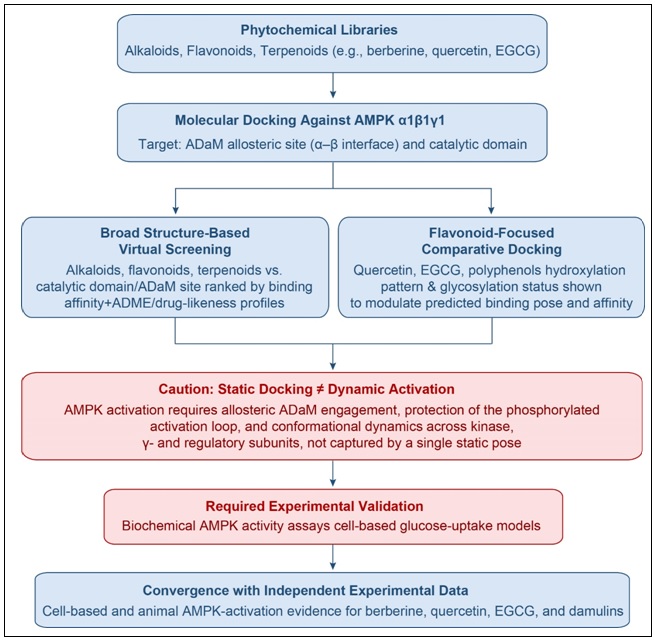
FIG. 1: WORKFLOW FOR STRUCTURE-BASED VIRTUAL SCREENING OF HERBAL AMPK ACTIVATORs. Phytochemicals (alkaloids, flavonoids, terpenoids) are docked against the AMPK α1β1γ1 heterotrimer, targeting the allosteric ADaM site at the α–β interface, the pocket engaged by synthetic activators (e.g., A-769662) and endogenous ligands such as salicylate. Compounds are ranked by predicted binding affinity, with flavonoid pose/affinity further modulated by hydroxylation and glycosylation pattern, and prioritized using ADME/drug-likeness profiles. Since static docking cannot capture the dynamic, multi-step nature of AMPK activation (activation-loop protection, conformational changes across regulatory subunits), favorable affinity is necessary but not sufficient; candidates require confirmation in biochemical and cell-based glucose-uptake assays. Convergence with experimental data for berberine, quercetin, EGCG, and damulins supports this computational–experimental pipeline.
Nanoformulation and Bioavailability Enhancement Strategies: A recurring translational obstacle for many of the phytochemicals discussed above, particularly the polyphenolic compounds curcumin and resveratrol, is poor oral bioavailability resulting from low aqueous solubility, extensive first-pass hepatic and intestinal glucuronidation/sulfation, and rapid systemic clearance. Curcumin exemplifies this problem acutely: despite consistent and robust AMPK-linked antidiabetic activity in cell-based and rodent models, plasma concentrations achieved after standard oral dosing in humans are typically far below those required to replicate these preclinical effects, a discrepancy that has motivated substantial pharmaceutical-sciences effort toward improved delivery systems 59. Co-administration with piperine, the pungent alkaloid of black pepper, was an early strategy proposed to inhibit hepatic and intestinal glucuronidation and thereby raise curcumin bioavailability, and several early clinical studies combining curcumin with piperine reported improved glycemic and lipid parameters in patients with prediabetes and type 2 diabetes 60. It should be noted, however, that subsequent independent replication attempts of the piperine–curcumin bioavailability enhancement have produced inconsistent results, and at least one controlled animal study reported that piperine co-administration paradoxically attenuated, rather than potentiated, curcumin’s antidiabetic and antioxidant effects, underscoring that this widely cited bioavailability strategy requires more rigorous confirmatory evidence before being assumed to reliably enhance clinical efficacy.
More recent formulation approaches have shifted toward nanoparticle-based encapsulation technologies, including liposomal, polymeric nanoparticle, solid lipid nanoparticle, and phospholipid-complex (phytosome) delivery systems, several of which have demonstrated substantially improved curcumin plasma exposure and tissue penetration relative to unformulated curcumin in both preclinical and early clinical studies 59. These nanoformulation strategies are conceptually attractive because they can, in principle, simultaneously address multiple pharmacokinetic bottlenecks enhancing aqueous solubility, protecting the compound from first-pass metabolism, and enabling sustained or tissue-targeted release although they introduce their own translational challenges, including manufacturing scalability, cost, regulatory characterization of nanomaterial safety, and batch-to-batch consistency of nanoparticle size and encapsulation efficiency. Analogous bioavailability concerns, albeit generally less severe, apply to resveratrol, EGCG, and quercetin, each of which undergoes substantial intestinal and hepatic conjugation, and nanoformulation and novel delivery approaches for these compounds are likewise under active investigation, though clinical validation specifically in the context of AMPK-linked glycemic endpoints remains at an early stage for most.
Polyherbal Formulations and Synergistic AMPK Activation: An alternative strategy to single-compound optimization or delivery engineering is the deliberate combination of multiple herbal extracts into polyherbal formulations designed to engage complementary or synergistic antidiabetic mechanisms, including AMPK activation, α-glucosidase and α-amylase inhibition, insulin secretagogue activity, and antioxidant and anti-inflammatory effects. In vitro screening of polyherbal blends combining several traditionally used antidiabetic plants has demonstrated that such combinations can act synergistically to enhance glucose metabolism, inhibit carbohydrate-digesting enzymes, and support insulin function more effectively than any single constituent extract alone, with methanolic extracts of the combined formulation showing particularly potent glucose-regulatory activity in cell-based assays 61. In-vivo work with a defined five-component polyherbal formulation (PHF5) administered to diabetic rodents demonstrated significant normalization of hyperglycemia, restoration of circulating insulin concentrations, and enhancement of hepatic and muscle AMPK activity alongside upregulation of GLUT1 and GLUT4 expression, providing direct evidence that a rationally combined polyherbal product can converge on the AMPK–GLUT axis to a greater extent than might be predicted from its individual components in isolation 62.
The rationale underlying polyherbal strategies is pharmacologically coherent given the multi-target nature of herbal antidiabetic constituents established throughout this review: if berberine, curcumin, resveratrol, and the newer botanicals discussed above each engage AMPK through partially distinct upstream triggers (mitochondrial complex I inhibition, CaMKKβ activation, PP2A downregulation, direct ADaM-site binding) while simultaneously modulating complementary non-AMPK pathways (PI3K/Akt, PPAR-γ, SIRT1, NF-κB, α-glucosidase inhibition), combining appropriately selected botanicals could in principle produce additive or synergistic glycemic benefit while permitting dose reduction of any individual component, thereby potentially improving the therapeutic index and minimizing herb-specific adverse effects. This same multi-target rationale, however, substantially complicates the pharmacological characterization of polyherbal products: standardization becomes markedly more difficult when multiple botanical sources, each with potential batch-to-batch variability in active constituent content, must be simultaneously controlled, and attribution of observed clinical benefit to specific mechanistic contributions AMPK-dependent or otherwise becomes correspondingly more difficult to establish with confidence. Rigorous polyherbal development therefore requires not only demonstration of superior efficacy relative to single-component extracts in head-to-head studies, but also chemically standardized manufacturing and, ideally, mechanistic deconvolution studies establishing the relative contribution of AMPK activation versus other pathways to the observed combined effect.
Clinical Evidence and Translational Considerations: Clinical evidence for herbal AMPK activators is most mature for berberine, for which meta-analyses of randomized controlled trials report reductions in HbA1c of approximately 0.7 percentage points and clinically meaningful reductions in fasting and postprandial glucose, alongside improved insulin sensitivity indices 55. Gynostemma pentaphyllum and Momordica charantia extracts have each demonstrated glucose-lowering efficacy in randomized trials of drug-naïve or prediabetic populations, and curcumin and resveratrol have shown benefit in trials targeting glycemic and cardiometabolic endpoints, albeit generally in smaller or shorter-duration studies than those available for berberine 18, 20, 45. Among the additional botanicals surveyed in this expanded review, clinical evidence is most developed for Nigella sativa, fenugreek, and mulberry leaf extract, each supported by multiple randomized trials or meta-analyses reporting significant, if generally modest, reductions in fasting glucose and HbA1c, whereas the clinical evidence base for Gymnema sylvestre, Astragalus membranaceus, Rhodiola rosea, and Salacia reticulata remains comparatively preliminary, consisting predominantly of smaller trials, uncontrolled studies, or extrapolation from robust preclinical mechanistic data.
Importantly, mechanistic uncertainty persists even for the most extensively studied compounds. Several lines of evidence indicate that berberine’s glucose-lowering action is not fully dependent on AMPK, with substantial contributions from AMPK-independent stimulation of glycolysis and inhibition of hepatic glucagon signaling 15, 16. This mechanistic pluralism is characteristic of herbal medicines generally: most plant extracts contain multiple bioactive constituents acting on several convergent and divergent pathways (AMPK, PI3K/Akt, PPAR-γ, SIRT1, NF-κB), which may confer therapeutic robustness but complicates attribution of clinical benefit to any single molecular target 21. This pattern recurs throughout the newer botanicals reviewed here: Gymnema sylvestre combines hepatic AMPK-linked signaling with intestinal glucose-absorption inhibition and insulinotropic effects; mulberry leaf combines AMPK-dependent mitochondrial and glucose-transport effects with AMPK-independent α-glucosidase inhibition by 1-DNJ; and Salacia reticulata combines AMPK-mediated hepatic lipogenic suppression with independent α-glucosidase inhibition by salacinol-type compounds. Clinicians and researchers should therefore interpret “AMPK activation” as one strand of supporting evidence rather than a complete mechanistic explanation for the clinical efficacy of these agents, and should be cautious about attributing the full clinical benefit of any polyphenolic or polysaccharide-rich extract to AMPK engagement alone.
Limitations and Future Directions: Several translational barriers constrain the clinical development of herbal AMPK activators. First, bioavailability is a major limitation for polyphenolic compounds such as curcumin and resveratrol, which undergo extensive first-pass metabolism; formulation strategies, such as co-administration with piperine or nanoparticle encapsulation, are being explored to address this, although as discussed above the evidence supporting piperine co-administration specifically is mixed and nanoformulation approaches, while promising, remain at an early stage of clinical validation 59, 60. Second, standardization of herbal extracts remains inconsistent across studies, with variable content of active constituents (e.g., damulins in Gynostemma, cucurbitane triterpenoids in Momordica, gymnemic acid content in Gymnema sylvestre, and polysaccharide molecular-weight distribution in Astragalus) confounding cross-study comparison and dose–response characterization 19, 25, 26. This standardization problem is compounded, rather than resolved, in polyherbal formulations, where multiple botanical sources must be simultaneously controlled and where mechanistic attribution to AMPK versus other pathways is correspondingly more difficult to establish 61. Third, most mechanistic data derive from in vitro or rodent models, and dedicated clinical biomarkers of AMPK activation such as tissue Thr172 phosphorylation status obtained from muscle or adipose biopsy are rarely incorporated into human trials, limiting direct confirmation that observed glycemic benefits are AMPK-mediated in patients 1. Fourth, potential herb–drug interactions warrant particular attention as herbal AMPK activators move toward wider clinical use, especially in combination with metformin and other conventional antidiabetic agents. Berberine has been repeatedly shown to inhibit several cytochrome P450 isoenzymes, including CYP2D6, CYP2C9, and CYP3A4, following repeated administration in humans, an effect with the potential to alter the pharmacokinetics of numerous co-administered medications metabolized by these enzymes 63.
Because CYP3A4 and CYP2D6 collectively metabolize a substantial proportion of commonly prescribed drugs including certain statins, antiarrhythmics, and psychotropic agents patients combining berberine with such medications may be at risk of clinically significant drug interactions, and structured pharmacokinetic interaction studies remain incompletely characterized for most of the newer botanicals reviewed here 64. Analogous concerns, though less thoroughly investigated, apply in principle to other cytochrome-modulating phytochemicals discussed in this review, including curcumin and EGCG, both of which have documented effects on drug-metabolizing enzymes and transporters at sufficiently high intake. Clinicians recommending or monitoring patients using these herbal agents alongside conventional pharmacotherapy should therefore remain alert to the possibility of altered drug exposure, particularly for narrow-therapeutic-index medications.
Finally, molecular docking and other computational structure–activity approaches, while valuable for prioritizing candidate compounds and rationalizing observed activity, cannot substitute for direct biochemical and cellular confirmation of AMPK engagement, and the field would benefit from more systematic integration of docking-based virtual screening with downstream experimental validation pipelines 57, 58.
Future research priorities include head-to-head and combination trials using standardized, chemically characterized extracts, including systematic comparison of the newer botanicals surveyed in this review (Gymnema sylvestre, Astragalus membranaceus, Morus alba, Rhodiola rosea, Nigella sativa, Trigonella foenum-graecum, and Salacia reticulata) against the more extensively studied berberine and Gynostemma pentaphyllum benchmarks; incorporation of tissue-level AMPK activity biomarkers into clinical protocols; structure activity studies, informed by molecular docking, to isolate the most potent and selective AMPK-activating constituents (e.g., damulins, cucurbitane triterpenoids, salidroside) as candidate leads for semi-synthetic optimization; rigorous, appropriately powered trials of nanoformulated curcumin and resveratrol specifically evaluating glycemic endpoints; formal head-to-head or factorial-design trials of rationally designed polyherbal combinations against their individual component extracts to establish genuine synergy rather than assumed additivity; and dedicated pharmacokinetic interaction studies characterizing the cytochrome P450 and transporter effects of the leading herbal AMPK activators, both individually and in combination with metformin and other standard antidiabetic agents.
CONCLUSION: AMP-activated protein kinase is a validated and mechanistically coherent target for the pharmacological management of hyperglycemia, and a chemically diverse array of herbal medicines and phytochemicals most prominently berberine, Gynostemma pentaphyllum, Momordica charantia, curcumin, resveratrol, and cinnamon, alongside an expanding panel of additional botanicals including Gymnema sylvestre, Astragalus membranaceus, Morus alba, Rhodiola rosea, Nigella sativa, Trigonella foenum-graecum, and Salacia reticulata modulate this pathway to improve glucose uptake, suppress hepatic glucose output, and enhance insulin sensitivity. Computational structure–activity work has begun to clarify how this chemically heterogeneous group of natural products engages the AMPK heterotrimer at the molecular level, while pharmaceutical strategies including nanoformulation and rationally designed polyherbal combination are actively being explored to overcome the bioavailability and standardization limitations that have historically constrained clinical translation. Clinical evidence, while encouraging and most robust for berberine, remains constrained by heterogeneous extract standardization, limited long-term safety and herb–drug interaction data, and incomplete mechanistic attribution to AMPK alone, a limitation that applies with particular force to the newer botanicals surveyed in this expanded review, for which the evidence base is still predominantly preclinical. Continued rigorous clinical investigation, informed by the mechanistic, computational, and formulation insights summarized here, is warranted to translate these promising botanical AMPK activators into evidence-based adjuncts for the management of type 2 diabetes.
ACKNOWLEDGMENTS: The authors would like to express their sincere gratitude to the Department of Genetics and Molecular Medicine, School of Para Medicine, Ilam University of Medical Sciences, Ilam, Iran, for their valuable cooperation and continuous encouragement, which greatly motivated the writing of this article.
CONFLICT OF INTEREST: The authors declare that there is no conflict of interest regarding the publication of this paper.
REFERENCES:
- Li M, Ding L, Cao L, Zhang Z, Li X and Li Z: Natural products targeting AMPK signaling pathway therapy, diabetes mellitus and its complications. Front Pharmacol 2025; 16: 1534634. doi:10.3389/fphar.2025.1534634
- Zaccardi F, Webb DR, Yates T and Davies MJ: Pathophysiology of type 1 and type 2 diabetes mellitus: a 90-year perspective. Postgrad Med J 2016; 92(1084): 63-9. doi:10.1136/postgradmedj-2015-133281
- Utami AR, Maksum IP and Deawati Y: Berberine and its study as an antidiabetic compound. Biology 2023; 12(7): 973. doi:10.3390/biology12070973
- Kahn BB, Alquier T, Carling D and Hardie DG: AMP-activated protein kinase: ancient energy gauge provides clues to modern understanding of metabolism. Cell Metab 2005; 1(1): 15-25. doi:10.1016/j.cmet.2004.12.003
- Hardie DG: AMPK: a target for drugs and natural products with effects on both diabetes and cancer. Diabetes 2013; 62(7): 2164-72. doi:10.2337/db13-0368
- Coughlan KA, Valentine RJ, Ruderman NB and Saha AK: AMPK activation: a therapeutic target for type 2 diabetes? Diabetes Metab Syndr Obes 2014; 7: 241-53. doi:10.2147/DMSO.S43731
- Zhang BB, Zhou G and Li C: AMPK: an emerging drug target for diabetes and the metabolic syndrome. Cell Metab 2009; 9(5): 407-16. doi:10.1016/j.cmet.2009.03.012
- Chauhan S, Singh AP, Rana AC, Kumar S, Kumar R and Singh J: Natural activators of AMPK signaling: potential role in the management of type-2 diabetes. J Diabetes Metab Disord 2023; 22(1): 47-59. doi:10.1007/s40200-022-01155-4
- Cortez-Navarrete M, Pérez-Rubio KG and Escobedo-Gutiérrez MdJ: Role of fenugreek, cinnamon, Curcuma longa, berberine and Momordica charantia in type 2 diabetes mellitus treatment: a review. Pharmaceuticals 2023; 16(4): 515. doi:10.3390/ph16040515
- Liu M, Wang R, Hoi MPM, Wang Y, Wang S and Li G: Nano-based drug delivery systems for managing diabetes: recent advances and future prospects. Int J Nanomedicine 2025; 20: 6221-52. doi:10.2147/IJN.S508875
- Joshi T, Singh AK, Haratipour P, Sah AN, Pandey AK and Naseri R: Targeting AMPK signaling pathway by natural products for treatment of diabetes mellitus and its complications. J Cell Physiol 2019; 234(10): 17212-31. doi:10.1002/jcp.28528
- Madhavi YV, Gaikwad N, Yerra VG, Kalvala AK, Nanduri S and Kumar A: Targeting AMPK in diabetes and diabetic complications: energy homeostasis, autophagy and mitochondrial health. Curr Med Chem 2019; 26(27): 5207-29. doi:10.2174/0929867325666180406120051
- Yin J, Gao Z, Liu D, Liu Z and Ye J: Berberine improves glucose metabolism through induction of glycolysis. Am J Physiol Endocrinol Metab 2008; 294(1): E148-56. doi:10.1152/ajpendo.00211.2007
- Jiang SJ, Dong H, Li JB, Xu LJ, Zou X and Wang KF: Berberine inhibits hepatic gluconeogenesis via the LKB1-AMPK-TORC2 signaling pathway in streptozotocin-induced diabetic rats. World J Gastroenterol 2015; 21(25): 7777-85. doi:10.3748/wjg.v21.i25.7777
- Xu M, Xiao Y, Yin J, Hou W, Yu X and Shen L: Berberine promotes glucose consumption independently of AMP-activated protein kinase activation. PLoS One 2014; 9(7): e103702. doi:10.1371/journal.pone.0103702
- Zhong Y, Jin J, Liu P, Song Y, Zhang H and Sheng L: Berberine attenuates hyperglycemia by inhibiting the hepatic glucagon pathway in diabetic mice. Oxid Med Cell Longev 2020; 2020: 6210526. doi:10.1155/2020/6210526
- Xiao Y, Xu M, Alimujiang M, Bao Y, Wei L and Yin J: Bidirectional regulation of adenosine 5′-monophosphate–activated protein kinase activity by berberine and metformin in response to changes in ambient glucose concentration. J Cell Biochem 2018; 119(12): 9910-20. doi:10.1002/jcb.27312
- Nguyen PH, Gauhar R, Hwang SL, Dao TT, Park DC and Kim JE: New dammarane-type glucosides as potential activators of AMP-activated protein kinase (AMPK) from Gynostemma pentaphyllum. Bioorg Med Chem 2011; 19(21): 6254-60. doi:10.1016/j.bmc.2011.09.013
- Tan MJ, Ye JM and Turner N, Hohnen-Behrens C, Ke CQ, Tang CP: Antidiabetic activities of triterpenoids isolated from bitter melon associated with activation of the AMPK pathway. Chem Biol 2008; 15(3): 263-73. doi:10.1016/j.chembiol.2008.01.013
- Mkhize SAL, Phoswa WN, Ngubane PS and Mokgalaboni K: Efficacy of Momordica charantia in glycaemic control and insulin resistance among patients with prediabetes and type 2 diabetes: a GRADE-adherent meta-analysis of randomised controlled trials. Metab Open 2025; 28: 100407. doi:10.1016/j.metop.2025.100407
- Zhang DW, Fu M, Gao SH and Liu JL: Curcumin and diabetes: a systematic review. Evid Based Complement Alternat Med 2013; 2013: 636053. doi:10.1155/2013/636053
- Na LX, Zhang YL, Li Y, Liu LY, Li R and Kong T: Curcumin improves insulin resistance in skeletal muscle of rats. Nutr Metab Cardiovasc Dis 2011; 21(7): 526-33. doi:10.1016/j.numecd.2009.11.009
- Jiménez-Flores LM, López-Briones S, Macías-Cervantes MH, Ramírez-Emiliano J and Pérez-Vázquez V: A PPARγ, NF-κB and AMPK-dependent mechanism may be involved in the beneficial effects of curcumin in the diabetic db/db mice liver. Molecules 2014; 19(6): 8289-302. doi:10.3390/molecules19068289
- Shen Y, Honma N, Kobayashi K, Jia LN, Hosono T and Shindo K: Cinnamon extract enhances glucose uptake in 3T3-L1 adipocytes and C2C12 myocytes by inducing LKB1-AMP-activated protein kinase signaling. PLoS One 2014; 9(2): e87894. doi:10.1371/journal.pone.0087894
- Li Y, Liu Y, Liang J, Wang T, Sun M and Zhang Z: Gymnemic acid ameliorates hyperglycemia through PI3K/AKT- and AMPK-mediated signaling pathways in type 2 diabetes mellitus rats. J Agric Food Chem 2019; 67(47): 13051-60. doi:10.1021/acs.jafc.9b04931
- Liu J, Zhang JF, Lu JZ, Zhang DL, Li K and Su K: Astragalus polysaccharide stimulates glucose uptake in L6 myotubes through AMPK activation and AS160/TBC1D4 phosphorylation. Acta Pharmacol Sin 2013; 34(1): 137-45. doi:10.1038/aps.2012.133
- Zou F, Mao XQ, Wang N, Liu J and Ou-Yang JP: Astragalus polysaccharides alleviates glucose toxicity and restores glucose homeostasis in diabetic states via activation of AMPK. Acta Pharmacol Sin 2009; 30(12): 1607-15. doi:10.1038/aps.2009.168
- Meng Q, Qi X, Fu Y, Chen Q, Yu X and Sun X: Flavonoids extracted from mulberry (Morus alba) leaf improve skeletal muscle mitochondrial function by activating AMPK in type 2 diabetes. J Ethnopharmacol 2020; 248: 112326. doi:10.1016/j.jep.2019.112326
- Kojima Y, Kimura T, Nakagawa K, Asai A, Hasumi K and Oikawa S: Effects of mulberry leaf extract rich in 1-deoxynojirimycin on blood lipid profiles in humans. J Clin Biochem Nutr 2010; 47(2): 155-61. doi:10.3164/jcbn.10-53
- Li HB, Ge YK, Zheng XX and Zhang L: Salidroside stimulated glucose uptake in skeletal muscle cells by activating AMP-activated protein kinase. Eur J Pharmacol 2008; 588(2-3): 165-9. doi:10.1016/j.ejphar.2008.04.036
- Ju L, Wen X, Wang C, Wei Y, Peng Y and Ding Y: Salidroside, a natural antioxidant, improves β-cell survival and function via activating AMPK pathway. Front Pharmacol 2017; 8: 749. doi:10.3389/fphar.2017.00749
- Tavakoli-Rouzbehani OM, Maleki V, Shadnoush M, Taheri E and Alizadeh M: A comprehensive insight into potential roles of Nigella sativa on diseases by targeting AMP-activated protein kinase: a review. DARU J Pharm Sci 2020; 28(2): 779-87. doi:10.1007/s40199-020-00376-3
- Shaukat A, Zaidi A, Anwar H and Kizilbash N: Mechanism of the antidiabetic action of Nigella sativa and thymoquinone: a review. Front Nutr 2023; 10: 1126272. doi:10.3389/fnut.2023.1126272
- Tak Y, Kaur M, Chitranashi A, Samota MK, Verma P and Bali M: Fenugreek derived diosgenin as an emerging source for diabetic therapy. Front Nutr 2024; 11: 1280100. doi:10.3389/fnut.2024.1280100
- Sarker DK, Ray P, Dutta AK, Rouf R and Uddin SJ: Antidiabetic potential of fenugreek (Trigonella foenum-graecum): a magic herb for diabetes mellitus. Food Sci Nutr 2024; 12(10): 7108-36. doi:10.1002/fsn3.4440
- Luan G, Wang Y, Wang Z, Zhou W, Hu N and Li G: Flavonoid glycosides from fenugreek seeds regulate glycolipid metabolism by improving mitochondrial function in 3T3-L1 adipocytes in-vitro. J Agric Food Chem 2018; 66(12): 3169-78. doi:10.1021/acs.jafc.8b00179
- Uemura T, Hirai S, Mizoguchi N, Goto T, Lee JY and Taketani K: Diosgenin present in fenugreek improves glucose metabolism by promoting adipocyte differentiation and inhibiting inflammation in adipose tissues. Mol Nutr Food Res 2010; 54(11): 1596-608. doi:10.1002/mnfr.200900609
- Li Y, Li Q, Wang C, Lou Z and Li Q: Trigonelline reduced diabetic nephropathy and insulin resistance in type 2 diabetic rats through peroxisome proliferator-activated receptor-γ. Exp Ther Med 2019; 18(2): 1331-7. doi:10.3892/etm.2019.7698
- Fuller S and Stephens JM: Diosgenin, 4-hydroxyisoleucine, and fiber from fenugreek: mechanisms of actions and potential effects on metabolic syndrome. Adv Nutr 2015; 6(2): 189-97. doi:10.3945/an.114.007807
- Neelakantan N, Narayanan M, de Souza RJ and van Dam RM: Effect of fenugreek (Trigonella foenum-graecum) intake on glycemia: a meta-analysis of clinical trials. Nutr J 2014; 13: 7. doi:10.1186/1475-2891-13-7
- Medagama AB: Salacia reticulata (Kothala himbutu) revisited; a missed opportunity to treat diabetes and obesity? Nutr J 2015; 14: 21. doi:10.1186/s12937-015-0013-4
- Siribaddana S, Medagama A, Wickramasinghe N, Siribaddana NM, Agampodi S, Fernando D. The effect of Salacia reticulata extract biscuits on blood sugar control of type 2 diabetes mellitus patients: a two-period, two-sequence, crossover, randomized, triple-blind, placebo-controlled, clinical trial. Cureus 2023; 15(9): e45921. doi:10.7759/cureus.45921
- Jung J, Park SH, Cho W, Lee M, Kim J and Gwon Y: Salacia reticulata extract improves insulin sensitivity and glucose homeostasis by activating insulin signaling and glucagon-like peptide-1 modulation. J Med Food 2025; 28(10): 1060-8. doi:10.1089/jmf.2025.k.0038
- Morikawa T, Ninomiya K, Tanabe G, Matsuda H, Yoshikawa M and Muraoka O: A review of antidiabetic active thiosugar sulfoniums, salacinol and neokotalanol, from plants of the genus Salacia. J Nat Med 2021; 75(3): 449-66. doi:10.1007/s11418-021-01522-0
- Lu C, Xing H, Yang L, Chen K, Shu L and Zhao X: Resveratrol ameliorates high-fat-diet-induced abnormalities in hepatic glucose metabolism in mice via the AMP-activated protein kinase pathway. Evid Based Complement Alternat Med 2021; 2021: 6616906. doi:10.1155/2021/6616906
- Jeong KJ, Quan HY, Jo HK, Kim GW and Chung SH: Effects of eugenol on hepatic glucose production and AMPK signaling pathway in hepatocytes and C57BL/6J mice. Fitoterapia 2014; 93: 150-62. doi:10.1016/j.fitote.2013.12.023
- Son MJ, Miura Y and Yagasaki K: Mechanisms for antidiabetic effect of gingerol in cultured cells and obese diabetic model mice. Cytotechnology 2015; 67(4): 641-52. doi:10.1007/s10616-014-9730-3
- Lee JO, Kim N, Lee HJ, Moon JW, Lee SK and Kim SJ: [6]-Gingerol affects glucose metabolism by dual regulation via the AMPKα2-mediated AS160-Rab5 pathway and AMPK-mediated insulin sensitizing effects. J Cell Biochem 2015; 116(7): 1401-10. doi:10.1002/jcb.25100
- Ong KW, Hsu A and Tan BKH: Chlorogenic acid stimulates glucose transport in skeletal muscle via AMPK activation: a contributor to the beneficial effects of coffee on diabetes. PLoS One 2012; 7(3): e32718. doi:10.1371/journal.pone.0032718
- Morvaridi M, Rayyani E, Jaafari M, Khiabani A and Rahimlou M: The effect of green coffee extract supplementation on cardio metabolic risk factors: a systematic review and meta-analysis of randomized controlled trials. J Diabetes Metab Disord 2020; 19(1): 645-60. doi:10.1007/s40200-020-00536-x
- Liu K, Zhou R, Wang B, Chen K, Shi LY and Zhu JD: Effect of green tea on glucose control and insulin sensitivity: a meta-analysis of 17 randomized controlled trials. Am J Clin Nutr 2013; 98(2): 340-8. doi:10.3945/ajcn.112.052746
- James A, Wang K and Wang Y: Therapeutic activity of green tea epigallocatechin-3-gallate on metabolic diseases and non-alcoholic fatty liver diseases: the current updates. Nutrients 2023; 15(13): 3022. doi:10.3390/nu15133022
- Dhanya R, Arya AD, Nisha P and Jayamurthy P: Quercetin, a lead compound against type 2 diabetes ameliorates glucose uptake via AMPK pathway in skeletal muscle cell line. Front Pharmacol 2017; 8: 336. doi:10.3389/fphar.2017.00336
- Wang DS, Wang JM, Zhang FR, Lei FJ, Wen X and Song J: Ameliorative effects of malonyl ginsenoside from Panax ginseng on glucose-lipid metabolism and insulin resistance via IRS1/PI3K/Akt and AMPK signaling pathways in type 2 diabetic mice. Am J Chin Med 2022; 50(3): 863-82. doi:10.1142/S0192415X22500367
- Guo J, Chen H, Zhang X, Lou W, Zhang P and Qiu Y: The effect of berberine on metabolic profiles in type 2 diabetic patients: a systematic review and meta-analysis of randomized controlled trials. Oxid Med Cell Longev 2021; 2021: 2074610. doi:10.1155/2021/2074610
- Moon DO: Plant-derived flavonoids as AMPK activators: unveiling their potential in type 2 diabetes management through mechanistic insights, docking studies, and pharmacokinetics. Appl Sci 2024; 14(19): 8607. doi:10.3390/app14198607
- Mazumdar S, Faruque MO, Islam T, Amin MR, Rakib MA and Alauddin M: Exploring natural AMPK activators from bioactive compounds in fenugreek and oyster mushroom for management of type 2 diabetes. Sci Rep 2025; 15(1): 44591. doi:10.1038/s41598-025-28349-z
- Calabrese MF: Structural basis for AMPK activation: natural and synthetic ligands regulate kinase activity from opposite poles by different molecular mechanisms. Structure 2014; 22(8): 1161-72. doi:10.1016/j.str.2014.06.009
- Quispe C: Therapeutic applications of curcumin in diabetes: a review and perspective. BioMed Res Int 2022; 2022: 1375892. doi:10.1155/2022/1375892
- Servida S: Overview of curcumin and piperine effects on glucose metabolism: the case of an insulinoma patient’s loss of consciousness. Int J Mol Sci 2023; 24(7): 6621. doi:10.3390/ijms24076621
- Sridevi N and Thirumal M: Evaluation of polyherbal synergy against diabetes: in-vitro Future Sci OA 2025; 11(1): 2468128. doi:10.1080/20565623.2025.2468128
- Ikechukwu GC: Polyherbal formular 5 normalises blood glucose level and reverses complications in diabetes via the upregulation of AMPKinase, GLUT 1 and GLUT 4 activities in albino rats. Phytomed Plus 2026; 6(1): 100939. doi:10.1016/j.phyplu.2025.100939
- Guo Y, Chen Y, Tan ZR, Klaassen CD and Zhou HH: Repeated administration of berberine inhibits cytochromes P450 in humans. Eur J Clin Pharmacol 2012; 68(2): 213-7. doi:10.1007/s00228-011-1108-2
- Feng X: Berberine in cardiovascular and metabolic diseases: from mechanisms to therapeutics. Theranostics 2019; 9(7): 1923-51. doi:10.7150/thno.30787.
How to cite this article:
Bastaminejad S and Ebrahimi E: Herbal modulation of hyperglycemia via AMPK activation. Int J Pharmacognosy 2026; 13(8): 726-41. doi link: http://dx.doi.org/10.13040/IJPSR.0975-8232.IJP.13(8).726-41.
This Journal licensed under a Creative Commons Attribution-Non-commercial-Share Alike 3.0 Unported License.
Article Information
1
726-741
1273 KB
535
English
IJP
Saiyad Bastaminejad and Esmaeil Ebrahimi *
Department of Biology, Faculty of Basic Sciences, Payame Noor University, Ilam, Iran.
e.ebrahimi.biology@gmail.com
12 July 2026
19 July 2026
23 July 2026
10.13040/IJPSR.0975-8232.IJP.13(8).726-41
01 August 2026
 Download