


EXTRACTION, PHYTOCHEMICAL INVESTIGATION AND ANTIMICROBIAL ACTIVITY OF CITRUS LIMON LEAF EXTRACT
HTML Full TextEXTRACTION, PHYTOCHEMICAL INVESTIGATION AND ANTIMICROBIAL ACTIVITY OF CITRUS LIMON LEAF EXTRACT
Ganesh D. Barkade *, Ramesh L. Sawant and Dnyaneshwar B. Hardas
Department of Pharmaceutical Chemistry, Dr. Vitthalrao Vikhe Patil Foundation’s College of Pharmacy, Vilad-Ghat, Ahilyanagar, Maharashtra, India.
ABSTRACT: Citrus limon is the commonly available medicinal plant in India. Which is utilized for the various pharmacological and food activities. During this year, commercial production of lemons was approximately 4.3 million tons that harvested from 25734 hectares in Iran. Nowadays, the interest in essential oils and their application in food preservation have been amplified as the natural additives to improve the shelf-life and the safety of food products, due to the risk in using synthetic preservatives. Also, food-borne diseases are a growing public health problem worldwide, calling for more impressive preservation tactics. Lemon has many bioactive components such as citric acid, Ascorbic acid, minerals, flavonoids and essential oils. In present work Citrus limon leaves subjected for extraction and followed by phytochemical Investigation and antimicrobial activity. The result shows that Citrus limon leaves ethanolic extract showing significant antimicrobial activity. The antimicrobial activity of the plant extract will be beneficial for the treatment of various microbial diseases such as fungal infection, skin rashes, ringworm and other skin related problems.
Keywords: Antimicrobial Activity, Citrus limon, Extraction, Lemon leaves, Phytochemical Investigation
INTRODUCTION: Lemon [Citrus limon (L.)] is a prominent member of the citrus family. The Rutaceae family contains roughly 130 genera divided into seven subfamilies that are used for a variety of purposes around the world. Lemon is a tiny evergreen tree that grows best in hotter regions, with global production exceeding 160 million tons in 2014. It has also been adapted to drier climates, such as those found in Iran.
Lemons were collected from 25734 hectares in Iran this year, resulting in a commercial yield of almost 4.3 million tones 1, 2. Due to the risk of employing synthetic preservatives, the interest in essential oils and their application in food preservation has grown. Furthermore, food-borne infections are an increasing public health concern around the world, necessitating more effective preservation techniques. Citric acid, ascorbic acid, minerals, flavonoids, and essential oils are just a few of the bioactive components found in lemons 1, 2.
Citrus essential oils are a complex mixture of over 400 elements with 85-99 percent volatile and 1-15 % non-volatile components that are generally regarded as safe (GRAS). Monoterpene, sesquiterpene, and their oxygenated derivatives make up the volatile components, whereas non-volatile chemicals include hydrocarbons, flavonoids, sterols, fatty acids, coumarins, waxes, carotenoids, and psoralens 3-4.
In addition lemon juice production, essential oils which acquired by cold pressing of the peel or distillation of leaves are broadly applied as an aroma enhancer in beverages, bakery and food products, also serves as a flavoring agent to mask the unpleasant taste of drugs in pharmaceutical, and as fragrance in perfumery and cosmetic industries Numerous studies have been performed on the chemical composition, antimicrobial, antifungal, antioxidant and radical scavenging abilities of the essential oils of peel and leaf of various species and/or cultivars of lemon around the world, where limonene has been always the prominent component found in all peel essential oils, whereas the leaf essential oil was generally rich in limonene, in some case other compounds were the major constituents. The primary component of Japanese lemon leaf oil was geranial, which was followed by limonene and neral.
Caryophyllene was found to be the most abundant component in Egyptian lemon leaf oil, followed by linalool, nerol, and limonene. While limonene was present in Italian, Turkish, and Chinese lemon leaf oils, it was followed by -pinene and geranial. The primary constituents of the Benin lemon leaf oils were limonene, -pinene, and citronellal. Although it is well known that limonene is one of the most common ingredients in lemon leaf oils, the composition of essential oils varies depending on where they are produced. Different agents, such as genetic, environmental, and experimental factors, influence the quality and quantity of essential oils 5.
To the best of our knowledge, no research has been done on the composition, antioxidant, or antibacterial properties of lemon leaf essential oils from Iran. The purpose of this work is to use GC-MS to identify the volatile constituents of essential oils from lemon leaves grown in the south of Iran and to assess their antioxidant activity using the DPPH radical scavenging test. Furthermore, the antibacterial activities of essential oils will be studied against six Gram positive and Gram negative microorganisms. Citrus essential oils are a complex mixture of over 400 elements with 85-99 percent volatile and 1-15 percent non-volatile components that are generally regarded as safe (GRAS). Monoterpene, sesquiterpene, and their oxygenated derivatives make up the volatile components, whereas non-volatile chemicals include hydrocarbons, flavonoids, sterols, fatty acids, coumarins, waxes, carotenoids, and psoralens 3-4.
Essential oils obtained by cold pressing the peel or distillation of the leaves are widely used as an aroma enhancer in beverages, bread, and culinary products, as well as a flavoring agent to disguise the bad taste of medications in pharmaceutical, and as fragrance in perfumery and cosmetic sectors. Many studies have been conducted around the world on the chemical composition, antimicrobial, antifungal, antioxidant, and radical scavenging abilities of the essential oils of the peel and leaf of various species and/or cultivars of lemon, where limonene has always been the most prominent component found in all peel essential oils, whereas the leaf essential oil was generally rich in limonene, in some cases other compounds were the major C.
The primary component of Japanese lemon leaf oil was geranial, which was followed by limonene and neral. Caryophyllene was found to be the most abundant component in Egyptian lemon leaf oil, followed by linalool, nerol, and limonene 3-4. While limonene was present in Italian, Turkish, and Chinese lemon leaf oils, it was followed by pinene and geranial. The primary constituents of the Benin lemon leaf oils were limonene, pinene, and citronellal. Lemon leaf essential oil has also been shown to have antibacterial and antioxidant properties in the past.
Although it is well known that limonene is one of the most common ingredients in lemon leaf oils, the composition of essential oils varies depending on where they are produced. Different agents, such as genetic, environmental, and experimental factors, influence the quality and quantity of essential oils. Furthermore, the antibacterial activities of essential oils will be studied against six Gram positive and Gram negative microorganisms. India is the world's most important and affordable source of medical plants and plant products. These medicinal herbs have been used extensively in Ayurvedic medicine for millennia.
Many of these plants have recently gained popularity as a result of their distinctive ingredients and diverse applicability in a variety of emerging disciplines of research and development. Nanoscience is centred on manipulating individual atoms and molecules to create materials for use at sub-microscopic scales. Physical, chemical, and biological knowledge at sizes ranging from single atoms and molecules below the nanometer to 100nm are included. During the last two decades, the production of nanoparticles has brought nanotechnology, which has resulted in innovative chemicals being used in a variety of industries. Diagnostics, antimicrobial agents, drug delivery, textiles (clothing), electronics, bio-sensing, food industry, paints, cosmetics, medical devices, and the treatment of several acute and chronic diseases such as malaria, hepatitis, cancer, and AIDS are all examples of pure metals in nanoparticle form 5-6. Lemon leaves are ovate, oblong, and taper to a point on the non-stem end and are small to medium in size. Green leaves with fine-toothed margins and a little rippling grow alternately along the branches. A prominent central stem with some tiny veins running throughout the leaf is also seen 7.
Kingdom: Plantae
Order: Pates
Family: Rutaceae
Genus: Cymbopogon
Species: Cymbopogon citrates

FIG. 1: LEMON AND ITS LEAF
MATERIALS AND METHODS:
Plant Material: Lemon levees were harvested in April from a nearby location in the Ahmednagar area and dried in the shade. It's important to choose organs that are typical and healthy.
Pharmacogenetic Study: For morphological and histological analyses, fresh leaves were obtained. Microscopical features, physicochemical parameters, and phytochemical inquiry were all investigated using coarse powder. Transverse sections of leaves were produced and stained as per normal procedure for microscopical examinations. The powder microscopy was carried out 8-9.
Physicochemical Investigation: Analysis The percentage of ash values and extractive values were determined using a well-established approved method and procedure. The conventional approach was used for preliminary screening 10-13.
Ash Value: Ash values, especially in powder form, are useful in establishing the quality and purity of crude pharmaceuticals. The goal of ashing vegetable medications is to get rid of any organic debris that might interfere with an analytical assessment. When crude pharmaceuticals are burned, they frequently produce an ash that contains carbonates, phosphates, and silicates of sodium, potassium, calcium, and magnesium 13-15.
Extraction of Lemon Levees Extract
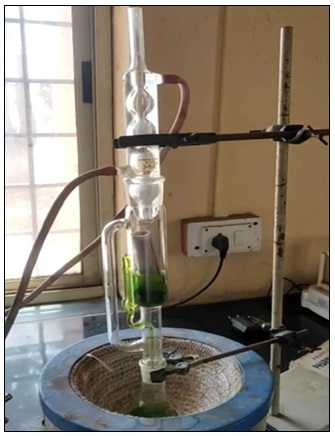
FIG. 2: SOXHLET’S EXTRACTION ASSEMBLY
Apparatus: Ethanol, weighing balance, two necked round bottom flask, heating mantle, thermometer, 500 ml healer, measuring cylinder, screening apparatus 14.
Procedure:
- First assembled the setup for Soxhlet extractor.
- Then next weight 40 gm. Lemongrass on weighing balance.
- Make thimble from filter paper add the lemongrass into the Thimble.
- Place the thimble in the Soxhlet chamber.
- Add 150 ml ethanol into the bottom flask.
- Place the flask in the heating mantle.
- Set the temperature at 90 degrees Celsius.
- Adjust the temperature of the heating mantle.
- Set the time of process for 1 hour then 1.20 min then 1.40 min. And take the runs according to the parameters.
Determination of Ash Values:
Total Ash: Take around 2 or 3 g of the ground drug, carefully weighed, and place it in a tarred platinum or silica dish that has been previously torched and weighed.
Place the ground drug in a fine, equal layer on the dish's bottom. Incarnated by progressively increasing the heat not surpassing dull red heat until carbon is removed, then cooled and weighed 15.
Acid- insoluble Ash: Boil the whole ash with 25 mL dilute hydrochloric acid for five minutes, collect the insoluble matter in a Gooch crucible or on ash-free filter paper, wash with hot water, ignite, and weigh. Calculate the percentage of acid-insoluble ash using the air-dried medication as a reference 16.
RESULTS AND DISCUSSION:
Phytochemical Test: After performing phytochemical test these components are present i.e. carbohydrate, Pentose sugar, Hexose sugar, Proteins, Amino acid, Flavonoid, Alkaloid, Steroids
TABLE 1: PHYTOCHEMICAL TESTS
| Sr. no. | Ingredients | Conclusion |
| 1. | Carbohydrate | + |
| 2. | Pentose sugar | + |
| 3. | Monosaccharides | - |
| 4. | Hexose sugar | + |
| 5. | Non reducing polysaccharides | - |
| 6. | Proteins | + |
| 7. | Amino acid | + |
| 8. | Fat and oil | - |
| 9. | Volatile oil | - |
| 10. | Glycosides | - |
| 11. | Steroids | + |
| 12. | Alkaloid | + |
| 13. | Flavonoid | + |
Physicochemical Analysis:
TABLE 2: PHYSICOCHEMICAL ANALYSIS OF POWDERED DRUG
| Name of test | Acid insoluble ash value | Sulphated ash value |
| Weight of empty dish | 59.01 gm | 59.01 gm |
| Weight of drug taken | 2 gm | 0.85 gm |
| Weight of ash + dish | 60.96 gm | 59.86 gm |
| Percentage of ash | 95% | 51% |
Antimicrobial Activity: The agar well diffusion method was used to test the antibacterial activity of lemon extracts against Gram positive and negative isolates. The microbial susceptibility was summed up in the water extracts of all the materials tested, which revealed a variety of inhibitory effects.
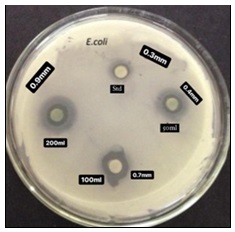
FIG. 3: ANTIMICROBIAL ACTIVITY OF E. COLI
TABLE 3: ANTIMICROBIAL TEST OF E. COLI
| Concentration (µg/ml) | Zone of Inhibition (mm) |
| 50 | 0.3 |
| 100 | 0.5 |
| 200 | 0.8 |
| Ciprofloxacin (STD) | 0.9 |
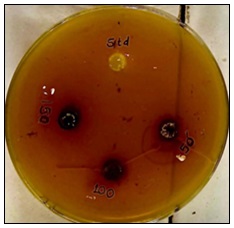
FIG. 4: ANTIMICROBIAL ACTIVITY OF S. AUREUS
TABLE 4: ANTIMICROBIAL ACTIVITY OF S. AUREUS
| Concentration (µg/ml) | Zone of Inhibition (mm) |
| 50 | 0.3 |
| 100 | 0.5 |
| 200 | 0.7 |
| Ciprofloxacin (STD) | 0.8 |
CONCLUSION: Citrus limon is a popular plant in India that has a variety of medicinal characteristics. Citrus limon leaves were extracted and then tested for phytochemicals and antibacterial activity in the current study. The results reveal that the ethanolic extract of Citrus limon leaves has strong antibacterial action. The plant extract's antimicrobial action will be effective in the treatment of a variety of microbial disorders, including fungal infection, skin rashes, ringworm, and other skin-related issues.
AKNOWLEDGEMENT: Authors are thankful to Dr. Vitthalrao Vikhe Patil Foundation’s College of Pharmacy, Vilad-Ghat, Ahilyanagar for providing laboratory facility.
CONFLICT OF INTEREST: Nil
REFERENCES:
- Locker J, El Tamer MK, Schwab W, Verstappen FW, van der Pals LH, Bouwmeester HJ and Verhoeven HA: Monoterpene biosynthesis in lemon (Citrus limon). European Journal of Bio Chemistry 2002; 269(13): 3160-71.
- AL-Jabri NN and Hossain MA: Comparative chemical composition and antimicrobial activity study of essential oils from two imported lemon fruits samples against pathogenic bacteria. Beni-Suef University Journal of Basic and Applied Sciences 2014; 3(4): 247-53.
- FAOstat: Agriculture organization of the United Nations. Statistical Database 2014.
- Tong nuanchan P and Benjakul S: Essential oils: extraction, bioactivities, and their uses for food preservation. Journal of Food Science 2014; 79(7): 1231-49.
- Di Vaio C, Graziani G, Gaspari A, Scaglione G, Nocerino S and Ritieni A: Essential oils content and antioxidant properties of peel ethanol extract in 18 lemon cultivars. Scientia Horti Culturae 2010; 126(1): 50-5
- Espina L, So Molino’s M, Loran S, Conch Ello P, García D and Pagán R: Chemical composition of commercial citrus fruit essential oils and evaluation of their antimicrobial activity acting alone or in combined processes. Food Control 2011; 22(6): 896-902.
- Ankita C, Nishanthini D and Abraham NSJ: Biosynthesis of Titanium Dioxide nanoparticles using Vigna radiata. Asian Journal of Pharmaceutical and Clinical Research 2016; 9(4): 85-88.
- Bang S, Patel M, Lippincott L and Meng X: Removal of arsenic from ground water by granular titanium dioxide adsorbent. Chemosphere 2005; 60: 389-397.
- Bissen M, Vuillard BMM, Scheindlin AJ and Frimmel FH: TiO2- catalyzed photo oxidation of arsenate to arsenate in aqueous samples. Chemosphere 2001; 44(4): 751-757.
- Gurr JR, Wang AS, Chen CH and KY: Ultrafine titanium dioxide particles in the absence of photo activation can induced oxidative damage to human bronchial epithelial cells. Toxicology 2005; 213(1-2): 66 -73.
- Kalpagam, S and Anndasan TK: Preparation of titanium dioxide nano particles and its application in waste water treatment. Journal of Chemical Biological and Physical Sciences 2014; 4(3): 1936-1940.
- Kumar V and Yadav SK: Nanaotechnology – A novel approach. International Journal of Green Nanotechnology 2011; 3(4): 281-291.
- Kwon S, Fan M, Cooper AT and Yang H: Photo catalytic applications of micro and nano-TiO2 in environmental engineering. Critical Reviews in Environmental Science and Technology 2008; 38: 197-226.
- Mohapatra B, Tura RK, Singh J, Kuriakose S and Mohapatra S: Biosynthesis of high concentration, stable aqueous dispersions of silver nano particles using Citrus limon extract. Advanced Materials Letters 2015; 6: 228-234.
- Newman MD, Stotland M and Ellis JI: The safety of nano size particles in titanium dioxide and zinc oxide based sun screams. Journal of the American Academy of Dermatology 2009; 61: 685 - 692.21.
- Mohapatra B, Tura RK, Singh J, Kuriakose S and Mohapatra S: Biosynthesis of high concentration, stable aqueous dispersions of silver nano particles using Citrus limon extract. Adv Materials Letters 2015; 6: 228-234.
How to cite this article:
Barkade GD, Sawant RL and Hardas DB: Extraction, phytochemical investigation and antimicrobial activity of Citrus limon leaf extract. Int J Pharmacognosy 2026; 13(6): 569-74. doi link: http://dx.doi.org/10.13040/IJPSR.0975-8232.IJP.13(6).569-74.
This Journal licensed under a Creative Commons Attribution-Non-commercial-Share Alike 3.0 Unported License.
Article Information
6
569-574
955 KB
202
English
IJP
Ganesh D. Barkade *, Ramesh L. Sawant and Dnyaneshwar B. Hardas
Department of Pharmaceutical Chemistry, Dr. Vitthalrao Vikhe Patil Foundation’s College of Pharmacy, Vilad-Ghat, Ahilyanagar, Maharashtra, India.
ganeshbarkade7@gmail.com
05 May 2026
15 May 2026
28 May 2026
10.13040/IJPSR.0975-8232.IJP.13(6).569-74
01 June 2026
 Download