



ETHNO-MEDICINAL FLORA OF THE SHAKAMBHARI CONSERVATION RESERVE: DOCUMENTATION OF TRADITIONAL PLANT USES IN THE JHUNJHUNU AND SIKAR DISTRICTS OF RAJASTHAN
HTML Full TextETHNO-MEDICINAL FLORA OF THE SHAKAMBHARI CONSERVATION RESERVE: DOCUMENTATION OF TRADITIONAL PLANT USES IN THE JHUNJHUNU AND SIKAR DISTRICTS OF RAJASTHAN
Priyanka * and Suman Lata Tripathi
P. G. Department of Botany, Govt. Dungar College, Bikaner, Rajasthan, India.
ABSTRACT: Herbal medicine and their application have always been the basis forman`s curiosity from the time immemorial. Averrhoa carambola is one of the best Indian cooling medicine. It is believed to be responsible for its sweet or sour taste, of which most of the members are traditional it reported remedies to disease in rural India. However, proper justification and validation of their traditional practice are lacking. Averrhoa carambola traditionally known as “kamrakh” and commonly known as star fruit because of its peculiar shape. It was widely in Ayurveda preparations of its fruits and leaves are used to pacify impaired kapha, pitta, skin diseases, pruritis, worm infestations, diarrhea, vomiting, hemorrhoids, intermittent fever, over-perspiration and general debility. The medicinal properties of Averhoa carambola includes anti-inflammatory, analgesic, hypotensive, anthelmintic, antioxidant, anti-ulcer, hypocholesterolemic, hypolipidimic, antimicrobial and antitumor activities. Hence we in tented to explore a comprehensive account of pharmacognostical and phytochemical updated profile.
Keywords: Ethno-medicine, Shakambhari Conservation Reserve, Aravalli hills, Rajasthan, Traditional knowledge, Medicinal plants
INTRODUCTION: The Shakambhari Conservation Reserve, notified in February 2012, is present in the Sikar and Jhunjhunu districts of Rajasthan, in the Aravalli hill range, and contains a repository of traditional ecological knowledge, which is sparsely documented in the scientific literature. This paper synthesizes the available field-based ethno-botanical surveys within and around the Reserve to consolidate the current knowledge on the ethno-medicinal flora of the Reserve.
This review, illustrated by two site-specific surveys, i.e. a comprehensive study that documented 20 species of medicinal plants belonging to 15 families used by the local communities for the treatment of 31 categories of diseases and a subsequent survey that recorded 20 ethno-medicinal species from 15 families from the Shakambhari hill tract of the larger Shekhawati region, outlines the taxonomic composition, dominant plant families, distribution of growth-forms and the principal categories of ailments treated, which include pain and general debility, respiratory infections, veterinary conditions and gastro-intestinal disorders. The review also highlights ethnoveterinary uses which appear to be specific to the region such as use of Crotalaria burhia to facilitate expulsion of retained placenta in cattle and use of Sarcostemma viminale and Ficus malis to increase milk yield. Comparison with earlier ethnobotanical surveys in Aravallis and Shekhawatizone reveals considerable overlap in floristics as well as locality specific practices.
The review concludes that traditional herbal knowledge in the Reserve is actively under threat from generational discontinuity, deforestation, overgrazing and unsustainable harvesting and calls for systematic, quantitative ethno-botanical documentation combined with community based conservation of both the plant resource base and the associated indigenous knowledge
Plants have been the foundation of human health care systems since ancient times and continue to be the first and often the only source of therapeutic intervention available to rural and forest-dependent communities in much of the developing world. The World Health Organization's (WHO) global assessment of traditional and complementary medicine indicates that such systems still constitute an important and often underappreciated health resource, particularly in the prevention and management of chronic, lifestyle-related conditions and to meet the healthcare needs of ageing populations across WHO member states (World Health Organization, 2019) 13. This dependence on herbal medicine is particularly apparent among rural, tribal and pastoral communities that inhabit forested and hilly tracts in India, where formal healthcare infrastructure is limited and locally available flora have historically substituted for institutional medicine.
A substantial amount of ethno-botanical research has recorded the folk medicinal use of the native flora of Rajasthan and the Aravalli hill range that runs through it. The traditional plant-based remedies of tribal communities living in the southern part of Aravalli have been documented in early and basic surveys, which have listed dozens of species used in folk healthcare and the richness of oral plant knowledge among the Bhil, Garasia, Damor, and other groups (Katewa, Chaudhary, Jain & Galav, 2003) 2. Later this documentation was extended to specific protected areas and administrative districts, e.g. medicinal flora of Sitamata Wildlife Sanctuary, folk remedies in reproductive and sexual health among tribes of southern Rajasthan, ethno-medicinal grasses of the state (Katewa, Guria, & Jain, 2001) 8, traditional plant use in Jodhpur district and medicinal plants conserved by specific communities of southern Rajasthan (Meena & Yadav, 2010) 9. One of the focused areas of research in this regard has been the semi-arid Shekhawati region of north-eastern Rajasthan comprising the districts of Sikar and Jhunjhunu, which has recorded the existence of tree-based folk remedies (Kapoor & Kishor, 2013) 4 and also the wider traditional herbal medicine practices of the area (Katewa & Galav, 2005) 3.
This tract is home to Shakambhari Conservation Reserve, an area of immense ecological and cultural importance. It was formally notified as a conservation reserve in February 2012, previously existing as the Raghunathgarh Reserve Forest Block (Rajasthan Forest Department, n.d.). The Reserve is anchored by the Shakambhari Shakti Peeth, a temple complex of considerable antiquity, and the Raghunathgarh peak, one of the higher points of the Aravalli range in this region. This is important and despite the wider ethno-botanical literature of Aravalli and Shekhawati, the Reserve itself was not the focus of much focused scientific research until recently when two field-based surveys captured the ethno-medicinal plant use of communities living in and around the Reserve (Soni, Khan, & Pareek, 2023) 12. Given the general rapid attrition of orally transmitted ecological knowledge and the specific pressures of deforestation, overgrazing and land-use change affecting the Reserve specifically, there is an urgent need to document what has been recorded, to place those data in the context of the broader regional ethno-botanical record and to identify areas for future research.
This paper therefore aims to:
- Synthesize the available ethno-botanical literature specific to the Shakambhari Conservation Reserve and its immediate Shekhawati–Aravalli context.
- Characterize the taxonomic composition, growth-form distribution, and principal therapeutic uses of the documented flora.
- Compare these findings with earlier surveys of the wider Aravalli and Shekhawati region.
- Outline the conservation concerns raised by the primary studies and the corresponding research priorities.
MATERIAL AND METHODOLOGY:
Study Site:
Location: Aravalli hills spreading across Sikar (8,070 hectares) and Jhunjhunu (5,030 hectares) districts.
Declaration Date: February 9, 2012, under Section 36-A of the Wild Life (Protection) Act, 1972.
Flora & Fauna: Home to panthers, sambhars, hyenas, 400+ plant varieties, and 225+ bird types.
Significance: Named after the sacred 1,100-year-old local Shakambhari Mata temple situated within the forest block.
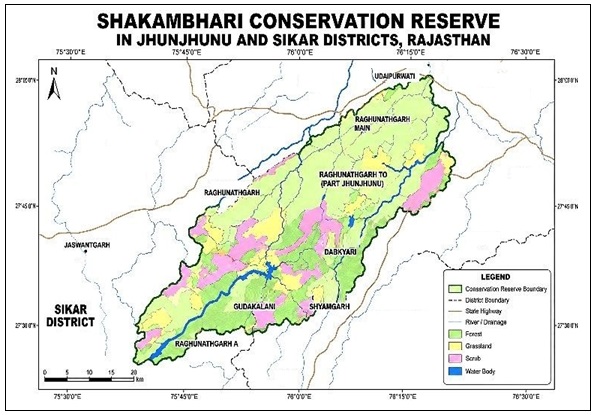
FIG. 1: MAP OF SHAKAMBHARI CONSERVATION RESERVE IN JHUNJHUNU AND SIKAR DISTRICTS OF RAJASTHAN (CREATED FROM QGIS 3.4)
The Shakambhari Conservation Reserve lies between approximately 27°34′N–27°43′N and 75°17′E–75°30′E, straddling the Sikar and Jhunjhunu districts of Rajasthan, with roughly 88.6 km² of its total 144.9 km² area falling within Sikar division and the remaining 56.3 km² within Jhunjhunu division (Rajasthan Forest Department, n.d.; Saini & Chauhan, 2019) 11.
The terrain is undulating, comprising broken hill ranges of 25–150 m relief above the surrounding plains, pediment zones, scattered plains, and, in its north-western portion, sand dunes and ravines.
The Raghunathgarh peak (1,055 m), among the higher points of the Aravalli range in this region, and the historic Shakambhari temple lie within the Reserve, alongside several natural springs, including Lohargal, Kirori Kund, and Nagkund.
METHODOLOGY: As this is a primary field survey, the methodology consisted of a structured search and synthesis of published ethnobotanical literature to the Shakambhari Conservation Reserve and the surrounding Sikar–Jhunjhunu (Shekhawati) tract of the Aravalli hills.
Inclusion Criteria: Studies were reported field-based ethno-botanical or ethno-medicinal data collected within the Shakambhari Conservation Reserve and reported comparable data from the immediately surrounding Shekhawati or Aravalli tract of Rajasthan and were comparable to the site-specific surveys.
Two studies met the first, more stringent criterion and form the primary evidence base for this study: a one-year interview-based survey of 18 informants across 10 villages within the Reserve, conducted between 2025 and 2026, and a subsequent floristic and ethno-medicinal survey of the Shakambhari hill tract conducted in 2025 and 2026. Approximately a dozen additional regional studies covering the wider Aravalli and Shekhawati ethno-flora were included as comparative and contextual sources.
Data Extraction and Synthesis: From each primary study, information was extracted on survey design (sampling method, informant demographics, duration), taxonomic composition of the documented flora (species, genera, families), growth-form distribution, plant parts used, mode of preparation, and the categories of ailment treated. These data were tabulated and compared across the two site-specific studies and against the wider regional literature to identify points of overlap, divergence, and locally distinctive practices. Because the underlying primary studies used simple descriptive and enumerative ethnobotanical methods rather than quantitative indices such as informant consensus factor or relative frequency of citation, this review is similarly descriptive in nature; this is noted as a limitation in the concluding section.
RESULTS AND DISCUSSION:
Diversity of the Documented Ethno-Medicinal Flora: Forest cover is classified as tropical dry deciduous and tropical thorn forest (Champion & Seth, 1968), dominated by Anogeissus pendula, with Boswellia serrata and Butea monosperma as other prominent tree species, and Justicia adhatoda as the principal shrub of the understory. The most comprehensive site-specific survey, conducted through interviews with 18 individuals above 50 years of age across 10 villages in and around the Reserve between 2015 and 2017, documented 61 medicinal plant species belonging to 60 genera and 36 families. Of these, 53 species were angiosperms; 31 families of dicotyledons and four families of monocotyledons; while two fern species from a single family were also recorded, reflecting a flora dominated by flowering plants with a small pteridophytic component. Fabaceae was the most represented family with eight species, followed by Malvaceae with four species, a pattern broadly consistent with the legume-rich composition typical of semi-arid Aravalli vegetation reported elsewhere in Rajasthan (Katewa et al., 2003) 6.
A subsequent survey focused specifically on the Shakambhari hill tract within the Shekhawati region, conducted in 2021–2022, recorded 35 ethno-medicinal plant species distributed across 22 families, again with Fabaceae as the dominant family (Soni et al., 2023) 12. This study also noted an elevational pattern in species distribution, with Justicia adhatoda widespread at lower hill elevations and Cactaceae members such as Opuntia becoming more prominent at upper elevations, alongside the presence of the medicinally valued Terminalia arjuna at the Nagkund locality. In terms of growth form, the more extensive survey classified the 20 documented species as 10 trees, 5 shrubs, 3 herbs, 2 climbers or creepers indicating that woody perennials (trees and shrubs combined) account for well over half of the medicinally used flora — consistent with a landscape in which perennial woody vegetation persists through the dry season and remains accessible for bark, gum, and leaf collection year-round.
TABLE 1: SUMMARIZES THE GROWTH-FORM COMPOSITION REPORTED BY THE PRIMARY SURVEYS
| Growth Form | No. of Species |
| Trees | 10 |
| Shrubs | 5 |
| Herbs | 3 |
| Climbers/Creepers | 2 |
| Total species | 20 (15 families) |
Principal Ailment Categories: Local communities in and around the Reserve reported using the documented flora against 31 distinct categories of ailment. Pain and general bodily tiredness formed the single largest category, treated using 13 species, followed by respiratory tract infections and veterinary ailments, each treated using 10 species. Gastro-intestinal complaints accounted for 8 species, and skin and wound-related conditions for 7 species, with smaller numbers of species reported for sexual health disorders, toothache, constipation, dysentery, eye problems, typhoid, fractured bones, arthritis, scorpion and snake bite, and other common complaints such as fever and headache (Saini & Chauhan, 2019).
TABLE 2: LIST OF THE DOCUMENTED ETHNO-MEDICINAL PLANT SPECIES, THE PRIMARY SOURCE OF MEDICINE FROM THE SHAKAMBHARI CONSERVATION RESERVE
| S. no. | Species (Family) | Habit | Local Name | Primary Traditional Use |
| 1 | Cassia fistula (Fabaceae) | Tree | Amaltas | Constipation, stomachache |
| 2 | Acacia tortilis (Fabaceae) | Tree | Kikar | Leucorrhoea, cough; abdominal pain |
| 3 | Butea monosperma (Fabaceae) | Tree | Palas | Pain, waist ache, chest/stomach pain |
| 4 | Prosopis cineraria (Fabaceae) | Tree | Khejri | Cattle dysentery, digestion |
| 5 | Cassia obtusifolia (Fabaceae) | Tree | Chakunda | insect bites, constipation, asthma |
| 6 | Anogeissus pendula (Combretaceae) | Tree | Dhonk | Pain, male impotence (gum) |
| 7 | Flacourtia indica (Salicaceae) | Tree | Kankun | Diarrhea |
| 8 | Ziziphus nummularia (Rhamnaceae) | Tree | Bair Jhadi | Goat dysentery, body cooling |
| 9 | Capparis decidua (Capparaceae) | Tree | Kair | Digestion (pickled fruit) |
| 10 | Cordia gharaf (Boraginaceae) | Tree | Goondi | Mouth ulcer |
| 11 | Justicia adhatoda (Acanthaceae) | Shrub | Aldusa | Typhoid, asthma, cough |
| 12 | Leptadeniapyrotechnica (Asclepiadaceae) | Shrub | Kheep | Constipation, gastric pain, spine removal |
| 13 | Calotropis procera (Asclepiadaceae) | Shrub | Aak | Scorpion sting, spine removal |
| 14 | Calligonumpolygonoides (Polygonaceae) | Shrub | Phog | Constipation, gastric pain |
| 15 | Withaniasomnifera (Solanaceae) | Shrub | Padalsi | Pain (human & animal) |
| 16 | Tinospora cordifolia (Menispermaceae) | Climber | Neem-giloy | Fever, arthritis, headache, jaundice |
| 17 | Aloe barbadensis (Liliaceae) | Herb | Gwarpatha | Nutrition |
| 18 | Pedalium murex (Pedaliaceae) | Herb | Gokhru | Male impotence |
| 19 | Citrullus colocynthis (Cucurbitaceae) | Creeper | Gurtumba | Gastric problems, diabetes |
| 20 | Aerva persica (Amaranthaceae) | Herb | Bui | Burns |
Noteworthy Species and Traditional Preparations: Several species recur across the primary surveys as especially significant to local healthcare practice. Terminalia arjuna, whose bark decoction is used for heart ailments, was reported to be restricted within the Reserve to a stand of seven mature trees at the Nagkund spring, underscoring both its therapeutic importance and its vulnerability as a locally rare resource (Saini & Chauhan, 2019 11; Soni et al., 2023) 12. Commiphora wightii (guggal) was recorded as a multipurpose species whose sap, bark, and wood powder are variously used for skin conditions, body ache, arthritis, and as a fumigant believed to reduce indoor pathogen load. Butea monosperma similarly yields several distinct preparations — gum for pain relief, and heated flowers applied topically for chest and abdominal pain. Ceropegia tuberosa was noted as a wild tuberous food plant whose roots are additionally used to manage kidney stones.
The survey also documented ethnoveterinary practices that appear to be locally distinctive rather than widely reported elsewhere in the regional literature. Crotalaria burhia, prepared as a boiled mixture with bamboo, jaggery, and milk, is used to aid the expulsion of retained placenta in goats after parturition, while Sarcostemma viminale and Ficus malis are both used as fodder specifically to enhance milk yield in cattle (Saini & Chauhan, 2019) 11. Dendrophthoe falcata, a parasitic plant growing on Boswellia serrata, was likewise reported as a common remedy for cattle ailments. The authors of the primary survey noted that such veterinary applications, together with the two parasitic species recorded, had not been highlighted to the same extent in earlier Shekhawati-region surveys, suggesting these represent locally emphasised or newly documented uses (Saini & Chauhan, 2019) 11.
Comparison with the Wider Aravalli and Shekhawati Ethno-botanical Record: When compared against two earlier surveys of traditional herbal medicine in the wider Shekhawati region, which had documented 50 and 40 species respectively, the Reserve-specific survey found an overlap of 21 species while identifying 61 species overall, of which a substantial proportion were not previously reported for the immediate locality (Katewa & Galav, 2005) 7. This pattern of partial overlap alongside locally distinct additions is consistent with the broader Aravalli ethnobotanical literature, in which Fabaceae recurs as the dominant medicinally used family across multiple independent surveys from the southern Aravalli tribal tract (Katewa et al., 2003) 6 to Sitamata Wildlife Sanctuary to southern Rajasthan communities (Meena & Yadav, 2010) 9 reflecting the ecological dominance of leguminous trees and shrubs (such as Acacia, Prosopis, and Butea species) in the region's dry deciduous and thorn-forest vegetation, and the correspondingly prominent role these taxa play in folk pharmacopoeia. At the same time, differences in the specific complement of species and in modes of preparation between neighbouring surveys point to genuine micro-regional variation in plant availability and in the oral transmission of herbal knowledge from one set of village informants to another (Saini & Chauhan, 2019) 11.
Threats to Plant Resources and Traditional Knowledge: Both primary surveys flag a set of interlinked threats to the long-term persistence of the Reserve's ethno-medicinal flora and the associated body of traditional knowledge. Deforestation for fuel wood and hedging material, combined with overgrazing, has measurably affected biodiversity within the Reserve over recent decades, while new saplings are reported to be frequently browsed by cattle before they can establish, impeding natural regeneration. Encroachment associated with settlement expansion along the Reserve boundary, and conversion of the sandy Shobh tract to agriculture, were specifically identified as placing species such as Leptadenia pyrotechnica, Calligonum polygonoides, and Crotalaria burhia at risk of local extirpation, while unsustainable harvesting practices in which the roots of Asparagus racemosus are collected without leaving sufficient root stock to regenerate — were reported to be driving a decline in that species. Independently, the erosion of traditional knowledge itself was highlighted as a concern in both surveys: informant recruitment in each case relied heavily on older residents, and both studies note that younger generations show comparatively little interest in retaining or continuing traditional herbal practices as hospital-based healthcare becomes more accessible. Beyond documentation and conservation, the more recent survey additionally frames the Reserve's ethnoflora as a potential resource for pharmacological research, motivated by the ongoing search for new antimicrobial compounds in the face of rising drug resistance.
CONCLUSION: The Shakambhari Conservation Reserve, spanning the Sikar and Jhunjhunu districts of Rajasthan along the Aravalli hill range, sustains a body of traditional ethno-medicinal knowledge that, while now documented in two dedicated field surveys recording between them roughly sixty distinct plant species across some three dozen families, remains comparatively under-studied relative to other parts of the Aravalli and Shekhawati tract. The available evidence indicates a flora dominated by Fabaceae and Malvaceae, a growth-form profile weighted toward trees and shrubs, and a therapeutic focus on pain, respiratory illness, gastro-intestinal complaints, and veterinary ailments, alongside locally distinctive ethnoveterinary practices such as the use of Crotalaria burhia, Sarcostemma viminale, and Ficus malis. This profile is broadly consistent with, while also adding meaningfully to, the wider ethnobotanical record of the Aravalli and Shekhawati regions. At the same time, both primary surveys converge on a common warning: the Reserve's medicinal flora and the knowledge attached to it face compounding pressure from deforestation, overgrazing, agricultural encroachment, unsustainable harvesting, and the declining transmission of herbal knowledge to younger generations. Future work would benefit from applying quantitative ethnobotanical indices such as informant consensus factor, relative frequency of citation, and fidelity level to enable more rigorous comparison across studies and to priorities species for pharmacological investigation and conservation; from extending systematic surveys to villages and sub-tracts of the Reserve not yet covered; and from pursuing conservation strategies that are co-designed with, and accountable to, the local communities whose knowledge and livelihoods are most directly tied to the Reserve's biodiversity.
ACKNOWLEDGEMENT: Nil
CONFLICT OF INTEREST: Nil
REFERENCES:
- Champion HG and Seth SK: A revised survey of the forest types of India. Government of India Publications 1968.
- Jain A, Katewa SS, Chaudhary BL & Galav P: Folk herbal medicines used in birth control and sexual diseases by tribals of southern Rajasthan, India. Journal of Ethno-pharmacology 2004; 90(1): 171–177. https://doi.org/10.1016/j.jep.2003.09.041
- Jain A, Katewa SS, Galav PK & Sharma P: Medicinal plant diversity of Sitamata Wildlife Sanctuary, Rajasthan, India. Journal of Ethno-pharmacology 2005; 102(2): 143–157. https://doi.org/10.1016/j.jep.2005.05.047
- Kapoor BBS & Kishor K: Some ethno-medicinal tree species of Shekhawati region of Rajasthan used in folk and herbal medicines. Unique Journal of Ayurvedic and Herbal Medicines 2013; 1: 5–9.
- Kapoor BBS & Lakhera S: Ethno-medicinal plants of Jodhpur district, Rajasthan used in herbal and folk remedies. Indian Journal of Pharmaceutical and Biological Research 2013; 1(4): 71–75. https://www.researchgate.net/publication/285900682_Ethnomedicinal_plants_of_Jodhpur_District_Rajasthan_used_in_herbal_and_folk_remedies
- Katewa SS, Chaudhary BL, Jain A & Galav PK: Traditional uses of plant biodiversity from Aravalli hills of Rajasthan. Indian Journal of Traditional Knowledge 2003; 2(1): 27–39. https://nopr.niscpr.res.in/bitstream/123456789/25918/1/IJTK%202(1)%2027-39.pdf
- Katewa SS & Galav PK: Traditional herbal medicines from Shekhawati region of Rajasthan. Indian Journal of Traditional Knowledge 2005; 4(3): 237–245. https://nopr.niscpr.res.in/bitstream/123456789/8512/1/IJTK%204(3)%20237-245.pdf
- Katewa SS, Guria BD & Jain A: Ethno-medicinal and obnoxious grasses of Rajasthan, India. Journal of Ethno-pharmacology 2017; 6(3): 293–297. https://doi.org/10.1016/S0378-8741(01)00233-1
- Meena KL & Yadav BL: Some traditional ethno-medicinal plants of southern Rajasthan. Indian Journal of Traditional Knowledge 2010; 9(3): 471–474. https://core.ac.uk/works/83080976
- Rajasthan Forest Department. (n.d.). Shakambhari Conservation Reserve management plan. Government of Rajasthan, Forest Department. https://forest.rajasthan.gov.in
- Saini TC & Chauhan SS: Traditional herbal medicines of Shakambhari Conservation Reserve, Rajasthan (India). Inter J of Res and Analytical Rev 2019; 6(1): 276–293. https://www.academia.edu/51098456/Traditional_Herbal_Medicines_of_Shakambhari_Conservation_Reserve_Rajasthan_India
- Soni S, Khan A & Pareek A: A survey report on ethno-medicinal plants of Shakambhari hills of Rajasthan, India. Flora and Fauna 2023; 29(1). https://www.researchgate.net/publication/371986809_A_survey_report_on_ethnomedicinal_plants_of_Shakambhari_hills_of_Rajasthan_India
- World Health Organization. (2019). WHO global report on traditional and complementary medicine 2019. World Health Organization. https://iris.who.int/handle/10665/312342
How to cite this article:
Priyanka and Tripathi SL: Ethno-medicinal flora of the Shakambhari conservation reserve: documentation of traditional plant uses in the Jhunjhunu and Sikar districts of Rajasthan. Int J Pharmacognosy 2026; 13(9): 950-56. doi link: http://dx.doi.org/10.13040/IJPSR.0975-8232.IJP.13(9).950-56.
This Journal licensed under a Creative Commons Attribution-Non-commercial-Share Alike 3.0 Unported License.
Article Information
6
950-956
736 KB
49
English
IJP
Priyanka * and Suman Lata Tripathi
P. G. Department of Botany, Govt. Dungar College, Bikaner, Rajasthan, India.
priyankakolsiya1998@gmail.com
11 August 2026
25 August 2026
27 August 2026
10.13040/IJPSR.0975-8232.IJP.13(9).950-56
01 September 2026
 Download