


GREVILLEA ROBUSTA A. CUNN.: ETHNOMEDICINAL USES, BIOACTIVE CONSTITUENTS, AND PHARMACOLOGICAL ACTIVITIES
HTML Full TextGREVILLEA ROBUSTA A. CUNN.: ETHNOMEDICINAL USES, BIOACTIVE CONSTITUENTS, AND PHARMACOLOGICAL ACTIVITIES
Shiv Pratap Singh Chauhan *, M. Himaja Trivedi and Satendra Sharma
Shri Ramnath Singh Institute of Pharmaceutical Science & Technology, Sitholi, Gwalior, Madhya Pradesh, India.
ABSTRACT: Grevillea robusta A. Cunn., an evergreen tree of the Proteaceae family, is valued for its timber, ornamental use, and rich phytochemical composition. Various plant parts-leaves, bark, flowers, and seeds contain flavonoids, tannins, saponins, phenolic acids, and novel compounds like graviquinone, contributing to diverse pharmacological activities. Studies demonstrate hepatoprotective, antioxidant, anti-inflammatory, antimicrobial, anticancer, anti-diabetic, and photocatalytic potentials. Leaf extracts protect against chemically induced liver damage, reduce oxidative stress, inhibit pathogenic bacteria, and improve lipid profiles in hypercholesterolemic models. Nanoparticle synthesis using G. robusta extracts shows eco-friendly applications in pollutant degradation. The bioactivity is largely attributed to polyphenols, flavonoids, and saponins, supporting traditional ethnomedicinal uses. These findings highlight G. robusta as a promising source of natural therapeutics and environmentally sustainable bioproducts. Further studies on molecular mechanisms, bioavailability, and clinical validation are recommended to harness its full medicinal potential.
Keywords: Grevillea robusta, Phytochemicals, Hepatoprotective, Antioxidant, Antimicrobial
INTRODUCTION: Since the beginning of human civilisation, medicinal plants have been an integral element of human culture to fight illnesses. The study of traditional human usage of plants, or ethnobotany, is acknowledged as a useful method for developing new medications 1. According to estimates from the World Health Organization (WHO), 80% of people in several Asian and African nations currently utilise herbal medicine for some form of basic healthcare 2, 3. One of the biggest families of flowering plants, the Proteaceae family includes more than 80 genera and 1800 species that have been identified worldwide 5.
It originated in Gondwana more than 100 million years ago 4. Australia is home to over 45 genera and 1100 species of the Proteaceae family, which is mostly found in the southern hemisphere. Of these, 37 genera are endemic to Australia 6. Carl Linnaeus coined the name Proteaceae in 1767, drawing inspiration from the Greek sea god Proteus 7. Robert Brown published the first monograph on the Proteaceae family in 1810. Based on the 38 genera discovered by Weston in 1995, the family was divided into two subfamilies 8.
The subfamilies were then eventually divided into five groupings by Peter Weston: Persoonioideae (5 genera), Bellendenoideae (1 genus), Grevilleoideae (47 genera), Proteoideae (25 genera), and Symphionematoideae (2 genera) 9. The Southern Hemisphere plant family Proteaceae include species such as Grevillea robusta, Banksia serrata, and Protea cynaroides.
Often referred to as silky oak or silver oak, Grevillea robusta is an evergreen tree that is indigenous to eastern Australia. In warm-temperate and subtropical climates, it is extensively grown for its sturdy wood and aesthetic appeal 10. Gardens, roadways, and landscapes are common places to plant this medium-sized to huge tree. It is prized for both its ecological flexibility and aesthetic importance and is a member of the Proteaceae family of flowering plants 11. The significance of plant-based chemicals has been brought to light in recent years by the increased interest in natural cures and sustainable healthcare. Grevillea robusta has garnered interest because of its varied pharmacological characteristics and extensive phytochemical makeup 12, 13. Plants have always been a significant source of therapeutic compounds, and current studies are confirming their promise. Research indicates that G. robusta may be beneficial in treating a number of illnesses, which makes it a worthwhile topic for more study.
Taxonomy:
- Kingdom: Plantae
- Division: Angiosperms
- Class: Eudicots
- Order: Proteales
- Family: Proteaceae
- Genus: Grevillea
- Species: Grevillea robusta Cunn 14.
The genus Grevillea comprises over 360 species, mostly native to Australia, with diverse growth forms including shrubs and trees.
Vernacular Names:
- English: Silk oak
- Assamese: Teli-wi
- Bengali: Rupasi
- Hindi: Khajur
- Kannada: Silver oak
- Manipuri: Koubilia
- Tamil Savukku-maram Chavukku 14.
Habit and Habitat: Grevillea robusta is a fast-growing, evergreen tree with a maximum height of 20 to 35 meters. It favours sunny spots, can withstand well-drained soils, and grows well in tropical and subtropical regions. It is frequently utilised in home gardens, roadsides, and plantations and is somewhat resistant to drought 15.
Geographical Distribution: Originally indigenous to eastern coastal Australia (New South Wales and Queensland), it has been brought to many parts of the world, including India, Africa, South America, and Southeast Asia, mostly for ornamentation and lumber 16, 17.
Botanical Description: Grevillea robusta is a tall, straight, evergreen tree that grows to a height of 10 to 25 meters. Its pinnate leaves are 15 to 33 centimetres long. Leaflets are sessile, olive green on top and silvery and hairy underneath, and range in size from seven to nineteen. It produces orange-yellow blooms on 5–15 cm racemes. Typical of the Proteaceae family, fruits are two-seeded follicles with widely winged seeds. Table 1 provided a botanical description 18.
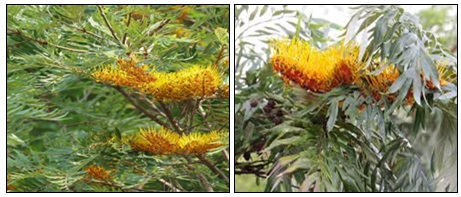
FIG. 1: GREVILLEA ROBUSTA PLANT
TABLE 1: BOTANICAL DESCRIPTION GREVILLEA ROBUSTA 19, 20
| Plant Part | Description |
| Habit | A handsome, straight evergreen tree, 10–25 m tall |
| Leaves | 15–33 cm long; leaflets 7–19, 3–12 cm long, sessile, entire or pinnatifid; olive green above, silvery-grey and silky hairy beneath; margins recurved |
| Inflorescence | 5–15 cm long; appear on old wood; solitary or few forming a panicle |
| Flowers | Solitary or in groups of 2–3 |
| Pedicel | 1–1.5 cm long, glabrous; leaves a permanent white lenticular scar |
| Sepals | 1.5–2 cm long, hooded; initially fused except on one side, later partly fused; colors range from orange-yellow to lemon yellow with dark red inner base |
| Stamens | Sessile; connective not extending beyond anther cells; anthers about 1 mm long |
| Ovary | Glabrous |
| Style | Lemon yellow, 1–2.5 cm long; dilated apex with greenish-yellow stigmatic cone (~1 mm) |
| Fruit | 2-seeded, 1.5–2 cm long, ~1 cm broad; silver-grey to olive green; dehiscent |
| Seeds | 1–1.5 cm long, 0.5–1 cm broad; broadly winged, thin, ovate, non-endospermic |
Ethnomedical Uses: Traditional uses of Grevillea robusta include:
- Anti-inflammatory: Leaf extracts applied to wounds and skin infections
- Fever and Pain Relief: Decoctions used in some indigenous practices
- Antimicrobial: Sap and leaf extracts for minor infections
- Other uses: Bark used in traditional medicine for digestive issues in some regions 21.
Phytochemistry: G. robusta is a treasure trove of bioactive compounds, with its various parts exhibiting a diverse phytochemical composition 22, 23.
- Leaves: robusta leaves contain a variety of chemicals, including flavonoids (quercetin, kaempferol, rutin), tannins (gallotannins, ellagitannins), phenolic acids (caffeic acid, gallic acid), and volatile oils (eucalyptol, limonene). Three new compounds: Graviquinone (1), cis-3-hydroxy-5-pentadecylcyclohexanone (2), and methyl 5-ethoxy-2-hydroxycinnamate (3), and thirty-eight known compounds were isolated and identified from the leaves of Grevillea robusta.
- Bark: robusta bark includes a high concentration of tannins, particularly condensed tannins, which contribute to its astringent qualities.
- Flowers: Flowers are high in flavonoids and phenolic substances including kaempferol glycosides, quercetin glycosides, and myricetin glycosides.3,5-dihydroxy cinnamate, 6-hydroxy coumarin, p-hydroxybenzeldahyde, Methyl gallate, Arbutin 6″-O-3,5-dihydroxycinnamic acid and Ethyl gallate.
- Seeds: They include important fatty acids (linoleic and oleic acid), proteins, and a range of medicinal substances.
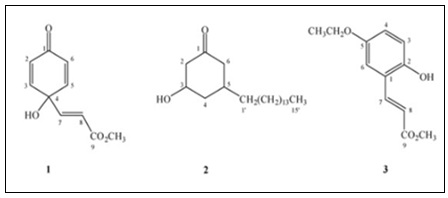
FIG. 2: GRAVIQUINONE (1), CIS-3-HYDROXY-5-PENTADECYLCYCLOHEXANONE (2), AND METHYL 5-ETHOXY-2-HYDROXYCINNAMATE (3) ISOLATED COMPOUND FROM G. ROBUSTA LEAVES 23
Pharmacological Uses:
Hepatoprotective Potential: Hameed S et al. (2022) investigated the hepatoprotective and antifibrotic effects of Grevillea robusta leaf extract in-vivo using CCl₄-induced liver injury in Wistar rats. The hydroethanolic extract, rich in polyphenols and flavonoids, showed strong antioxidant activity. Treatment significantly reduced serum ALT and γ-GT levels, increased RBC count, and decreased alpha-SMA expression and collagen deposition. Histological findings revealed reduced necrosis and extracellular matrix accumulation, indicating protection against liver fibrosis 23.
Similarly, Bhardwaj S et al. (2025) evaluated the hepatoprotective potential of ethanolic leaf extract of G. robusta using CCl₄- and paracetamol-induced hepatotoxicity models. The extract significantly lowered ALT, AST, ALP, and bilirubin levels, enhanced antioxidant enzymes (SOD, CAT), and reduced lipid peroxidation. Histological studies confirmed improved liver structure with less inflammation and necrosis. These findings suggest G. robusta as a promising natural agent for managing liver disorders 24.
Photocatalytic Activity: Ejeta et al. (2026) reported the green synthesis of zinc oxide (ZnO), copper oxide (CuO), and ZnO/CuO nanocomposites using Grevillea robusta leaf extract. The plant extract acted as a natural reducing and stabilizing agent, making the process eco-friendly and sustainable. The synthesized nanomaterials were characterized and evaluated for their functional properties. The study found that ZnO/CuO nanocomposites showed superior photocatalytic activity compared to individual metal oxides, effectively degrading methylene blue dye under sunlight. This enhanced efficiency highlights the potential application of G. robusta-mediated nanomaterials in environmental remediation, particularly for the removal of harmful organic pollutants from industrial wastewater 11.
Antimicrobial: Ullah et al. (2014) evaluated the pharmacological activities of methanolic leaf extract of Grevillea robusta and its solvent fractions. The crude extract showed strong cytotoxicity in the brine shrimp assay, while the carbon tetrachloride fraction exhibited notable thrombolytic activity. The chloroform fraction demonstrated significant membrane-stabilizing and antimicrobial effects, particularly against Salmonella typhi 15. Afzal et al. (2019) further reported the termiticidal potential of G. robusta leaf extract against Heterotermes indicola, showing over 90% mortality, reduced tunneling, and antifeedant effects. High phenolic and alkyl-resorcinol content suggested its application as an eco-friendly botanical insecticide 12.
Kumar and Sindhu (2019) explored the green synthesis of silver nanoparticles using G. robusta leaf extract, confirming their eco-friendly and cost-effective production. The nanoparticles exhibited strong antibacterial activity against both gram-positive and gram-negative bacteria 13. Similarly, Ian Edwin Cock et al. (2019) investigated antibacterial properties of Grevillea species, including G. robusta, demonstrating effective inhibition of several bacterial strains such as Bacillus cereus and Staphylococcus aureus, while showing no antifungal activity. Importantly, the extracts were found to be non-toxic, highlighting their potential for developing safe and effective antibacterial therapies 20.
Anticancer: Chuang et al. (2011) investigated the phytochemical profile of Grevillea robusta leaves and isolated three novel compounds-graviquinone, cis – 3 – hydroxyl - 5-pentadecylcyclohexanone, and methyl 5-ethoxy-2-hydroxycinnamate-along with several known constituents. Among these, graviquinone exhibited strong cytotoxic activity against cancer cell lines such as MCF-7, NCI-H460, and SF-268. Additionally, other isolated compounds demonstrated significant antioxidant and tyrosinase inhibitory activities, highlighting the plant’s pharmacological importance 17.
Tareq et al. (2016) explored the anticancer potential of G. robusta bioactive compounds targeting estrogen receptor alpha (ER-α), which plays a critical role in breast cancer progression. Molecular docking studies identified compounds like 4-hydroxyacetophenone, bisnorstriatol, grasshopper ketone, and p-coumaric acid as potential inhibitors. Among them, grasshopper ketone showed the highest binding affinity, indicating its promise as a selective ER-α inhibitor, though further experimental validation is needed 14.
Anti-oxidant Activity: Wei et al. (2012) studied the structural composition and antioxidant potential of polymeric proanthocyanidins extracted from the leaves, stem bark, and fine roots of Grevillea robusta. The analysis showed that these compounds mainly consisted of procyanidins and prodelphinidins with different degrees of polymerization. The extracts exhibited strong free radical scavenging activity, surpassing standard antioxidants, highlighting the plant’s effectiveness as a natural source of antioxidant compounds. These findings emphasize the potential of G. robusta in developing antioxidant-based therapeutic applications 16.
Anti-inflammatory Activity: Ahmed (2006) examined the phytochemical composition and biological activities of alcoholic extracts from the leaves, bark, and fruits of Grevillea robusta cultivated in Egypt. The extracts demonstrated significant anti-inflammatory activity in carrageenan-induced edema models and showed moderate inhibition of HIV-1 protease and reverse transcriptase. Several bioactive compounds, including phenolic glycosides and sterols, were identified, supporting the plant’s pharmacological potential 18.
Samanta and Kumar (2021) focused on the anti-inflammatory activity of G. robusta leaves. Pharmacognostic parameters such as fiber length, ash values, and extractive values were established, and chemical tests confirmed the presence of polyphenols. The ethanol leaf extract (GRLE) was evaluated using HRBC and heat-induced hemolytic assays, showing significant in-vitro anti-inflammatory activity. These results suggest that the polyphenol-rich leaf extract of Grevillea robusta could serve as a natural therapeutic agent for managing inflammation 21.
Anti-diabetic Activity: Hypercholesterolemia is a major contributor to the pathophysiology of coronary heart disease and myocardial ischemia. Lowering cholesterol levels is considered a key strategy to reduce cardiovascular risk. In this context, the ethanol leaf extract of Grevillea robusta (GRLE) was evaluated for its hypocholesterolemic effects in rats fed a high-cholesterol diet (HCD) composed of maize, soybean meal, coconut cake, rice polish, groundnut cake, and animal tallow. HCD-fed rats showed significantly elevated plasma total cholesterol (TC) and triglycerides (TG) compared to normal controls. Treatment with GRLE significantly reduced serum TC, TG, LDL, and VLDL levels while improving HDL levels. The lipid-lowering effect is attributed to bioactive compounds such as saponins and flavonoids. Saponins can precipitate cholesterol from micelles and disrupt the enterohepatic circulation of bile acids, forcing the liver to convert more cholesterol into bile, thereby lowering serum cholesterol. Additionally, saponins may reduce triglycerides by inhibiting pancreatic lipoprotein lipase. Flavonoids complement this effect through antioxidant activity, collectively improving lipid profiles and potentially reducing the risk of premature atherosclerosis and other cardiovascular diseases 22.
CONCLUSION: Grevillea robusta demonstrates significant pharmacological potential, validated by contemporary research. Its rich phytochemical profile, including flavonoids, saponins, phenolic acids, and novel bioactive compounds, underpins its diverse therapeutic effects. Leaf extracts show hepatoprotective, anti-inflammatory, antioxidant, antimicrobial, anticancer, and hypocholesterolemic activities, while nanocomposite applications highlight environmental benefits. Traditional uses are supported by scientific evidence, confirming its value in ethnomedicine. The bioactive compounds, particularly polyphenols and flavonoids, contribute to modulation of oxidative stress, lipid metabolism, and microbial inhibition. These findings suggest G. robusta as a promising candidate for developing natural therapeutic agents and sustainable bioproducts. Further in-vivo, clinical, and mechanistic studies are essential to establish efficacy, safety, and pharmacokinetics, paving the way for potential pharmaceutical, nutraceutical, and environmental applications.
ACKNOWLEDGEMENT: Nil
CONFLICT OF INTEREST: Nil
REFERENCES:
- Bijauliya RK, Jain SK, Alok S, Dixit VK, Singh D and Singh M: Dalbergia sissoo An overview: morphology, phytochemistry and pharmacology. Int J Pharm Sci Res 2017; 8(4): 1522–33. doi: 10.13040/IJPSR.0975-8232.8(4).1522-33
- Lai PK and Roy J: Antimicrobial and chemopreventive properties of herbs and spices. Curr Med Chem 2004; 11(11): 1451–60.
- Bijauliya RK, Alok S, Kumar M, Chanchal DK, Sabharwal M and Yadav RD: An update of pharmacological activity of Psidium guajava in the treatment of various diseases. Int J Pharm Sci Res 2018; 9(3): 883–93. doi: 10.13040/IJPSR.0975-8232.9(3).883-93
- Kubitzki K: Flowering Plants: Eudicots. Berlin, Germany: Springer 2014; 1–332.
- Christenhusz MJM and Byng JW: The number of known plants species in the world and its annual increase. Phytotaxa 2016; 261: 201–17. doi:10.11646/phytotaxa.261.3.1
- Goldingay RL and Carthew SM: Breeding and mating systems of Australian Proteaceae. Aust J Bot 1998; 46: 421–37. doi:10.1071/BT97054
- Jussieu AL de: Genera Plantarum secundum Ordines Naturales disposita. Paris, France: Theophilum Barrois; 1789.
- Weston PH: Flora of Australia Volume 16, Elaeagnaceae, Proteaceae 1. Melbourne, Australia: CSIRO Australia; 1995.
- Weston P and Barker N: A new suprageneric classification of the Proteaceae, with an annotated checklist of genera. Telopea 2006; 11: 314–44. doi:10.7751/telopea20061105
- Ejeta SY, Bekere LB, Kenei WD and Gaol JML: Grevillea robusta leaf extract-assisted fabrication of ZnO/CuO nanocomposites for enhanced degradation of methylene blue dye. Results Chem 2026; 22: 103097.
- Afzal M, Farman M, Rasib KZ and Qureshi NA: Biocidal action of silver oak (Grevillea robusta) leaf extract on the termite Heterotermes indicola Wasmann (Blattodea: Rhinotermitidae). Int Biodeterior Biodegrad 2019; 139: 1–10.
- Kumar P and Sindhu A: Green synthesis of silver nanoparticles using Grevillea robusta. In: AIP Conference Proceedings. AIP Publishing 2019; 2142: 1.
- Tareq SM, Islam MN, Shahadat S, Guha B, Azad MA and Ikram M: Anticancer potential of isolated phytochemicals from Grevillea robusta against breast cancer: in-silico molecular docking approach. World J Pharm Res 2016; 5: 1358–65.
- Ullah MS, Sikder MAA, Sharmin T and Rashid MA: Pharmacological activities of Grevillea robusta, a medicinal plant of Bangladesh. Bangladesh Pharm J 2015; 17(2): 135–37. doi:10.3329/bpj.v17i2.22329
- Wei SD, Lin YM, Liao MM, Chai WM and Zhou HC: Structural composition and free radical scavenging activity of proanthocyanidins extracted from Grevillea robusta. Records Nat Prod 2012; 6(3).
- Chuang TH, Chan HH, Wu TS and Li CF: Chemical constituents and biological studies of the leaves of Grevillea robusta. Molecules 2011; 16(11): 9331–9. doi:10.3390/molecules16119331
- Ahmed AS: Phytochemical and biological study of Grevillea robusta Cunn cultivated in Egypt. Bull Pharm Sci Assiut 2006; 29(2): 272–88. doi:10.21608/bfsa.2006.65200
- Sukumar D and Parimala K: Phytochemical studies on Grevillea robusta Cunn. ex R.Br. GJRA Glob J Res Anal 2014; 3(2): 7–8.
- Cock IE: Grevillea juncifolia and Grevillea robusta A. Cunn. Ex. R. Br. Methanolic leaf and flower extracts inhibit the growth of Gram positive and Gram- negative bacteria. Pharmacogn Commun 2019; 9(3): 112–7.
- Samanta J and Kumar V: Evaluation of in-vitro anti-inflammatory potential of Grevillea robusta Cunn, EX R. Br. leaves. Int J Pharm Sci Rev Res 2021; 68(1): 117–20.
- Mittal S, Taygi S, Kumar R, Kumar R, Dubey A and Chourasia A: Effect of Grevillea robusta leaf on antidiabetic activity. J Cardiovasc Dis Res 2021; 12(4).
- Yamashita-Higuchi Y, Sugimoto S, Matsunami K, Otsuka H and Nakai T: Grevillosides J-Q, arbutin derivatives from the leaves of Grevillea robusta and their melanogenesis inhibitory activity. Chem Pharm Bull 2014; 62: 364–72.
- Hameed S, Ur Rehman A, Massey S, Syed NI, Anwar F and Ahmed D: Grevillea robusta delayed the progression of experimentally induced hepatic fibrosis and cirrhosis in Wistar rats by attenuating the expression of smooth muscle actin, collagen, and TGF-β. Front Pharmacol 2022; 13: 904584. doi:10.3389/fphar.2022.904584
- Bhardwaj SK and Satapathy T: A Systematic Review on Hepatoprotective Medicinal Plants, Their Bioactive Compounds, and Pharmaceutical Formulations. Journal of Drug Delivery and Therapeutics 2025; 15(12): 193-216DOI:10.22270/jddt.v15i12.7500
How to cite this article:
Chauhan SPS, Trivedi MH and Sharma S: Grevillea robusta a. cunn.: ethnomedicinal uses, bioactive constituents, and pharmacological activities. Int J Pharmacognosy 2026; 13(4): 264-69. doi link: http://dx.doi.org/10.13040/IJPSR.0975-8232.IJP.13(4).264-69.
This Journal licensed under a Creative Commons Attribution-Non-commercial-Share Alike 3.0 Unported License.
Article Information
5
264-269
699 KB
200
English
IJP
Shiv Pratap Singh Chauhan *, M. Himaja Trivedi and Satendra Sharma
Shri Ramnath Singh Institute of Pharmaceutical Science & Technology, Sitholi, Gwalior, Madhya Pradesh, India.
mspharma8081@gmail.com
27 March 2026
08 April 2026
13 April 2026
10.13040/IJPSR.0975-8232.IJP.13(4).264-69
30 April 2026
 Download