


A CYTOTOXIC STEROID FROM BERRIES OF SOLANUM INCANUM GROWING IN OMAN
HTML Full TextA CYTOTOXIC STEROID FROM BERRIES OF SOLANUM INCANUM GROWING IN OMAN
Z. A. Daway, A. M. Weli, J. Shaikh, M. S. Akhtar and S. A. Said *
School of Pharmacy, College of Health Sciences, University of Nizwa Oman PB 33, PC 616, Nizwa, Oman.
ABSTRACT: In pursuit of anticancer metabolites from natural sources, we examined organic extracts of Solanum incanum berries collected in Oman. The ethyl acetate fraction demonstrated significant inhibition of Carbonic Anhydrase (CA) activity, with an IC₅₀ value of 20.20 ± 1.2 µg/ml. From this fraction, a β-sitosterol derivative was isolated and shown to suppress the proliferation of MCF-7 breast cancer cells by 71.5% in the MTT assay. These findings suggest that S. incanum represents a promising source of potential anticancer agents.
Keywords: Anticancer, Beta-sitosterol, Carbonic anhydrase, MCF-7, Solanum incanum
INTRODUCTION: Solanum incanum L is a shrub growing in dry tropical biome and is native to Africa, Arabian peninsula and SW India 1. Numerous biological activities have been recorded for plant species in the genus Solanum. This plant species have analgesic, anthelminthic, antianemic, antibacterial, antifungal, antileishmanial, antitrypanosomal, antiprotozoa, antiplasmodial, schistosomicidal, anti-allergic, anti-inflammatory, anti-nociceptive, antihistaminic, anti-asthmatic, anti-diabetic, anti-cancer, cardio-vascular, hypolipidemic, antihypertensive, diuretic, anti-convulsant, antimelanogenetic, anti- anti-psoriatic, molluscicidal, antiurolithiatic, antiviral, mosquito larvicidal, nephrotoxic, spasmolytic, and vasorelaxant properties 2. Traditional medicine uses Solanum species to treat a variety of conditions, including angina, sore throat, stomach discomfort, toothache, headache, pain from pleurisy, liver pain,
painful menstruation, pneumonia, rheumatism, and river blindness 3-8. Natural products that have been isolated from S. incanum include alkaloids, flavonoids, saponins, reducing sugars, proteins, phenols, glycosides, terpenoids, anthraquinone, resins, steroids, tannins & cardiac glycosides 2.
Our investigation on some medicinal plants collected from Oman showed organic extracts from S. incanum to be active against some of the tested cancer cell lines 9.
This paper report isolation of a cytotoxic steroid 1 (Fig. 1) from berries of S. incanum collected from Jabal Akhdhar, Oman.
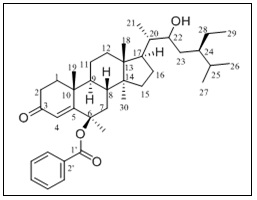
FIG. 1: STRUCTURE OF COMPOUND 1
MATERIALS AND METHODS:
General Experimental Procedures: All of the solvents were of analytical grade and were used without additional purification. Methanol, hexane, chloroform, dichloromethane, and ethyl acetate were purchased from J.T. BAKER, India. Silica gel used was 63 -200 micron and was obtained from Merck Germany. Nuclear Magnetic Resonance (NMR) experiments were conducted with a Bruker Ascend 600 MHz machine. Protons (1H) were recorded at 600 MHz, while carbons (13C) were measured at: 150.9 MHz). Signals are described in parts per million (δ) in reference to the experimental solvent. Infra-Red (IR) spectra were taken on Shimadzu IR-435 Spectrophotometer. The Mass spectra were recorded using the Agilent Technologies 6530 Accurate Mass Q-TOF-LC/MS.
Sample Collection and Preparation of Extracts: Berries of S. incanum were obtained from Jabal Akhdhar, Oman. The species was identified by Dr. Amna Al Farsy at Sultan Qaboos University (SQU). A voucher specimen no. Al-Farsi, A. 567 is deposited at SQU herbarium. The sample was dried in the shade for two weeks and pulverized to give coarse powder. About 300 g of the powder was macerated in methanol for 48 hours and then filtered to give clear solution. The experiment was repeated two times. Methanol was then removed at low pressure and the resulting crude extract was Kupchan’s partitioned to give extracts of varying polarities including hexane, chloroform, ethyl acetate and butanol.
Compound 1 - Benzoyl β-Sitosterol: The extract of ethyl acetate was tested using vacuum liquid chromatography on silica gel, eluting with hexane and increasing concentrations of ethyl acetate, due to its strong action against carbonic anhydrase. Evaporation of solvent from a fraction obtained while eluting the column with 30% EtOAc/hexane gave brownish-white gum containing one major compound based on TLC. Gel filtration of the gum using Sephadex LH-20 eluting with methanol gave pure compound 1. 15.4 mg, HRMS ESI+ m/z 563.4121 [M+H]+ (calcd for C37H55O4 563.4100), 1H-&13C-NMR data Table 1.
Carbonic Anhydrase (CA) Assay: Inhibition of CA was done by a method described by Supuran and coworkers 10. In a typical experiment: test sample (in DMSO 0.5 mM) 20 µL, the HEPES-tris 140 µL, the enzyme (0.1 mg/mL) 20 µL and the substrate 4-NPA (0.7 mM) 20 µL were placed in a well in a 96 well plate. The experiment was started by incubating a mixture of the test samples and the enzyme in the buffer for 15 min. After adding 20 µL of substrate, the SpectraMax M2, USA was used to monitor the rate of product formation at 400 nm at 1-minute intervals for 30 minutes. DMSO was used as a negative control while Acetazolamide (Standard inhibitor) was a positive control.
Cytotoxicity Assay (MTT Assay): Cytotoxicity assay used Cancer Cells (Human Breast Cells) – MCF-7 and Normal Cells (Human Fibroblast Cells) – BJ-HTERT. The cells were purchased from ATCC®. The experiment was done using MTT Assay Kit (BI-2004-5) from Sigma Aldrich.
Protocol of MTT Assay: Each well contained 7000 cells and was kept for 24 hours to make sure the growth and distribution are good. To minimize error, 97 µL of cell medium and 3 µL of 3% pure compound were added to each experiment's cells. The experiment was duplicated and monitored for activity over a 24-hour period. The cell medium was taken out and 100 µL of the Ready-To-Use RPIN1640 (MTT media) was added after the 24-hour period. Each well received 10 µL of the MTT stock solution (MTT Reagent). The plate was incubated at 37°C for three hours. Following the incubation period, the MTT reagent and medium were withdrawn. Each well was then filled with 50 µL of the DMSO. After that, it was incubated at 37°C for 5 minutes. At 570 nm, the absorbance was measured.
Data Analysis of MTT Assay: The absorbance data were used to calculate the percent inhibition of the cells by using the following equation:
% Cell inhibition = 100 - (A1-Ao) / (A2-Ao ) × 100
Where, A1: absorbance of tested compound, A0: absorbance of the blank (without any cells), A2: absorbance of control (only cells).
RESULTS AND DISCUSSION:
Structure of Compound 1: The molecular formula of compound 1 deduced from spectroscopic data is C37H54O4. Table 1 displays the 1D and 2D-NMR data of compound 1. The isolated compound contains a monosubstituted benzene ring, as evidenced by the 1H and 13CNMR data. Absorption values and the HMBC correlations of the phenyl protons suggest the ring to be part of benzoate functionality. Apart from the benzoate system, the rest of the protons and carbon-13 signals correspond to those of β-sitosterol 11. As a result, the seven methyl protons of the β-sitosterol were found to have characteristic absorption at δ 0.62 (3H, br, s), 0.83 (3H, m), 0.91 (3H, m), 0.93 (3H, m), 0.96 (3H, d, J = 6.72), 1.10 (3H, d, J = 5.91 Hz), and 1.31 (3H, m) in the 1H-NMR spectrum.
TABLE 1: NMR DATA FOR COMPOUND 1 IN CDCL3*
| Carbon | δ13C | Multp. | δ1H | HMBC |
| 1 | 38.8 | CH2 | 2.14; 1.47 (2H, m) | C-3, C-2 |
| 2 | 36.2 | CH2 | 1.87; 1.62 (2H, m) | C-2, C-4 |
| 3 | 200.1 | C | – | C-10, C-13 |
| 4 | 123.6 | CH | 5.71 (1H, d, J = 2.34 Hz) | |
| 5 | 161.0 | C | – | |
| 6 | 78.9 | CH | 4.69 (1H, ddd, J1 = 10.81 Hz; J2 = 10.70 Hz; J3 = 4.71 Hz) | C-5, C-1’ |
| 7 | 41.4 | CH | 1.28 (1H, m) | |
| 8 | 42.6 | CH | 1.73 (1H, m) | |
| 9 | 54.9 | CH | 2.06 (H, m) | |
| 10 | 39.3 | C | – | |
| 11 | 21.7 | CH2 | 1.80; 1.63 (2H, m) | |
| 12 | 42.8 | CH | 1.73 (1H, m) | |
| 13 | 45.1 | C | – | |
| 14 | 53.1 | C | – | |
| 15 | 23.6 | CH2 | 1.47 (1H, m); 1.28 (1H, t, J1 = J2 = 3.82 Hz) | |
| 16 | 30.0 | CH2 | 1.25; 1.04 (2H, m) | |
| 17 | 60.0 | CH | 2.27 (1H, d, J = 10.89 Hz) | C-10, C-24, C-30 |
| 18 | 11.8 | CH3 | 0.91 (3H, m) | |
| 19 | 20.5 | CH3 | 0.93 (3H, m) | |
| 20 | 31.8 | CH | 1.73 (1H, brs) (d, J = 10.30 Hz) | |
| 21 | 17.6 | CH3 | 0.83(3H, s), | |
| 22 | 71.0 | CH | 3.75 (1H, d, J = 10.29 Hz) | C-20, C-21 |
| 23 | 26.1 | CH2 | 2.01; 1.23 (2H, m) | |
| 24 | 51.0 | CH | 2.26 (1H, m) | |
| 25 | 28.7 | CH | 1.70 (1H, m) | |
| 26 | 17.4 | CH3 | 0.85 (3H, m) | |
| 27 | 14.7 | CH3 | 0.96 (3H, d, J = 6.72 Hz) | |
| 28 | 22.5 | CH2 | 1.62; 1.54 (2H, m) | |
| 29 | 12.5 | CH3 | 0.97 (3H, m) | |
| 30 | 12.3 | CH3 | 0.62(3H, br, s) | |
| 1’ | 166.4 | C | – | |
| 2’ | 130 | C | – | |
| 3’&7’ | 129.6 | CH | 8.06 (2H, dd, J1 = 8.10 Hz; J2 = 1.37 Hz) | C-1’, C-5’, C-3’/7’ |
| 4’ & 6’ | 128.4 | CH | 7.45 (2H, t, J1 = J2 = 7.73 Hz) | C-2’, C-4’/6’ |
| 5’ | 132.8 | CH | 7.56 (1H, m) | C-3’/7’ |
The characteristic olefinic proton H-4, of this steroid resonated as doublet at δ 5.70 (1H, d, J = 2.34 Hz). Based on HMBC correlations, the downfield methine signals at δ 4.69 and δ 3.75 were attributed to the oxygenated protons H-6 and H-22. A total of 37 carbon signals were identified in the 13C-NMR spectrum of compound 1.
Seven of these signals were assigned to the benzoate substituent at position 6 while the remaining 30 account for the β-sitosterol skeleton. The 13C-NMR signal at δ 200.1ppm C-3 suggested oxidation of the characteristic hydroxyl group of the sterol to a keto system. The benzoate group was placed at position 6 based on HMBC cross peaks between H-6 absorbing at δ 4.69 and C-1’ resonating at δ 166.4.
Assignment of stereochemistry was based on the NOESY spectrum and the reported inherent biogenetic configuration of the β-sitosterol skeleton.
On basis of this information the isolated compound is identified as 17 - (5 – ethyl – 3 - hydroxy – 6 -methylheptan-2-yl)-2, 3, 6, 7, 8, 9, 10, 11, 12, 13, 14, 15, 16, 17-tetradecahydro-10,13,14-trimethyl-3-oxo-1H-cyclopenta[a]phenanthren-6b-yl benzoate (1) Fig. 1.
Isolation of this compound from S. incanum is reported for the first time. However, the same compound was previously isolated from berries of another Solanum species, S. aculeastrum collected from Kenya 12. Hence, the isolated derivative of β-sitosterol could be used as a biomarker for chemotaxonomic identification of Solanum species.
Inhibition of Carbonic Anhydrase by Extracts of S. Incanum: In the initial testing of the extracts at higher concentration (0.2 mg/mL) only ethyl acetate extract inhibited CA at 71.5% which was greater than the cut-off value (70%) for active sample. This extract gave IC50 value 20.20 ± 1.20 µg/ml in further experiment at six diluted concentrations ranging from 62.5 – 1000 µg/ml.
In-vitro Cytotoxic Activity of Compound 1: Compound was active against the tested cancer cell it inhibited the growth of MFC-7 by 76.02% Table 2. However, it also inhibited the growth of the normal cells (Fibroblast, BJ-HTERT) at higher percentage (82.12%). These preliminary results suggest that while the isolated compound has demonstrated potent in-vitro activity against human breast cancer cell line (MCF-7), it could also be toxic as it inhibits the normal cell growth almost at the same level.
TABLE 2: % GROWTH INHIBITION OF MFC-7 AND BJ-HTERT BY COMPOUND 1
| Cells type | Inhibition % |
| MCF-7 | 76.02 |
| BJ-HTERT | 82.12 |
CONCLUSION: In conclusion S. incanum is a potential source of bioactive metabolites for development of anticancer agents but some of its products need optimization for practical application.
ACKNOWLEDGEMENTS: We express our gratitude to University of Nizwa for providing material support.
CONFLICTS OF INTEREST: Nil
REFERENCES:
- Fadl MA, Alamer KH, Alharth MA, Hassan WA, Korany SM, Al-Yasi HM and Alsherif EA: Taxonomical study on genus Solanum (Solanaceae) in Taif region, Saudi Arabia. Phytotaxa 2023; 616(3): 207–222. https://doi.org/10.11646/phytotaxa.616.3.1
- Kaunda JS and Zhang YJ: The genus solanum: an ethnopharmacological, phytochemical and biological properties review. Natural Products and Bioprospecting 2019; 9(2): 77-137. https://doi.org/10.1007/s13659-019-0201-6
- Maling S, Kabakyenga J, Muchunguzi C, Olet EA, Namaganda M, Kahwa I and Alele PE: Medicinal plants used by traditional medicine practitioners in treatment of alcohol-related disorders in Bushenyi District, southwestern Uganda. Frontiers in Pharmacology 2024; 15:407104.https://doi.org/10.3389/fphar.2024.1407104
- Schultz F, Anywar G, Wack B, Quave CL and Garbe LA: Ethnobotanical study of selected medicinal plants traditionally used in the rural Greater Mpigi region of Uganda. Journal of Ethnopharmacology 2020; 256: 112742. https://doi.org/10.1016/j.jep.2020.112742
- Muhakr MAYM, Ahmed IM, El Hassan GOM and Yagi S: Ethnobotanical study on medicinal plants in Melit area (North Darfur), Western Sudan. Journal of Ethnobiology and Ethnomedicine 2024; 20(1): 3. https://doi.org/10.1186/s13002-023-00646-9
- Eskandari M, Assadi M, Shirzadian S and Mehregan I: Ethnobotanical study and distribution of the Solanum section Solanum species (Solanaceae) in Iran. Quarterly Scientific Research Journal of Medicinal Plants 2019; 18(71): 85-98.
- Umair M, Altaf M and Abbasi AM: An ethnobotanical survey of indigenous medicinal plants in Hafizabad district, Punjab-Pakistan. PloS one 2017: 12(6): e0177912.https://doi.org/10.1371/journal.pone.0177912
- Gafforov Y, Rašeta M, Zafar M, Makhkamov T, Yarasheva M, Chen JJ, Zhumagul M, Wang M, Ghosh S, Abbasi AM and Yuldashev A: Exploring biodiversity and ethnobotanical significance of Solanum species in Uzbekistan: unveiling the cultural wealth and ethnopharmacological uses. Frontiers in Pharmacology 2024; 14: 1287793. https://doi.org/10.3389/fphar.2023.1287793
- Said SA, Tamimi Y, Akhtar MS, Weli AM, Al-Khanjari SS and Al-Riyami QA: In-vitro anticancer activity of selected medicinal plants from Oman. Br J Pharm Res 2017; 15(5): 1-8. https://doi.org/10.9734/BJPR/2017/32459
- Supuran CT, Scozzafava A and Casini A: Carbonic anhydrase inhibitors. Medicinal Research Reviews 2003; 23(2): 146-89. https://doi.org/10.1002/med.10025
- Pham XP, Nhung TT, Trinh HN, Trung DM, Giang DT, Vu BD, Diep NT, Long NV, Nguyen VT and Men CV: Isolation and structural characterization of compounds from Blumealacera. Pharmacogn J 2021; 13: 999-1004. http://dx.doi.org/10.5530/pj.2021.13.129
- Kama-Kama F, Omosa LK, Nganga J, Maina N, Osanjo G, Yaouba S, Ilias M, Midiwo J and Naessens J: Antimycoplasmal Activities of Compounds from Solanum aculeastrum and Piliostigma thonningii against Strains from the Mycoplasma mycoides Cluster. Frontiers in Pharmacology 2017; 8: 920. https://doi.org/10.3389/fphar.2017.00920
How to cite this article:
Daway ZA, Weli AM, Shaikh J, Akhtar MS and Said SA: A cytotoxic steroid from berries of Solanum incanum growing in Oman. Int J Pharmacognosy 2026; 13(7): 721-25. doi link: http://dx.doi.org/10.13040/IJPSR.0975-8232.IJP.13(7).721-25.
This Journal licensed under a Creative Commons Attribution-Non-commercial-Share Alike 3.0 Unported License.
Article Information
12
721-725
490 KB
115
English
IJP
Z. A. Daway, A. M. Weli, J. Shaikh, M. S. Akhtar and S. A. Said *
School of Pharmacy, College of Health Sciences, University of Nizwa Oman PB 33, PC 616, Nizwa, Oman.
sadri@unizwa.edu.om
09 June 2026
23 June 2026
29 June 2026
10.13040/IJPSR.0975-8232.IJP.13(7).721-25
01 July 2026
 Download