


A COMPREHENSIVE REVIEW ON THE THERAPEUTIC POTENTIAL OF WILD SUGARCANE (SACCHARUM SPONTANEUM LINN.)
HTML Full TextA COMPREHENSIVE REVIEW ON THE THERAPEUTIC POTENTIAL OF WILD SUGARCANE (SACCHARUM SPONTANEUM LINN.)
Shanmuga V. Deepika *, V. Ruth, V. Adithya, V. Srimathi, R. Padma and A. Sathish
GRD College of Pharmacy, Thiruvallur, The Tamil Nadu Dr. M.G.R Medical University, Chennai, Tamil Nadu, India.
ABSTRACT: Saccharum spontaneum L., commonly known as Kasa and belonging to the Poaceae family, is a perennial grass native to tropical Asia with extensive traditional medicinal uses. It addresses various ailments such as burning sensations, obesity, dyspepsia, mental illness, urinary tract infections, and reproductive and respiratory issues. In Ayurveda, it functions as an astringent, emollient, diuretic, purgative, tonic, and aphrodisiac. The Siddha system also utilizes Kasa for mental disorders, abdominal issues, dyspnoea, anaemia, and obesity. Phytochemical studies demonstrate its richness in quinones, alkaloids, saponins, tannins, carbohydrates, proteins, coumarin, phenols, steroids, terpenoids, and glycosides. This review details the plant's chemical composition, safety, traditional applications, and pharmacological effects. Modern pharmacological research validates these claims, notably its anti-urolithiatic activity, diuretic, antioxidant, anti-inflammatory, antimicrobial, and CNS modulatory effects observed in various studies. The review highlights the comprehensive evidence supporting Kasa's use in managing renal calculi and inflammatory conditions, advocating for further clinical studies to explore its potential in standardized phytopharmaceutical development.
Keywords: Kasa, Saccharum spontaneum, Anti-urolithiatic, Ayurveda, Quinones
INTRODUCTION: Saccharum spontaneum, commonly known as Kasa or wasteland weed, is a tall perennial grass from the Poaceae family. Found throughout tropical Asia, including India, and in regions such as tropical Australia and parts of America and Africa, it can reach heights of up to 4 meters. Often considered a significant weed, it spreads widely due to its rhizomes and deep roots, leading to abandonment of infested fields. S. spontaneum is thought to be an ancestor of cultivated sugarcane (S. officinarum L.) and can reproduce both sexually and asexually, thriving in various environments. Leaves and stalks contain lignin, proteins, carbohydrates, and amino acids.
Roots and root stocks contain starch and polyphenolic chemicals. Blood disorders, biliousness, hemorrhagic diathesis, burning feelings, strangury, phthisis, and vesical calculi might all benefit from aerial parts. Additionally, they have aphrodisiac and laxative properties. The stems can help with dyspepsia, hemorrhoids, menorrhagia, dysentery, agalactia, phthisis, and general debility 1, 2.
Saccharum spontaneum is recognized by Ayurveda as an essential medicinal herb that is used to cure a number of ailments, such as dyspepsia, burning sensations, piles, and respiratory problems. Its roots have astringent, purgative, and aphrodisiac qualities. While fresh juice from its stems is used in Indian tribal rituals to treat mental health difficulties, the entire plant helps with stuttering, blood diseases, and other maladies. The Philippines has also reported using it medicinally 3. The species' culm is mostly used to make pulp, particularly for the creation of grease-proof paper.
Local communities use leaves for thatching as well as for making a variety of crafts such ropes, mats, baskets, and brooms. These leaves are good for making silage and can be fed to young goats and camels. They work well as mulch because of their sluggish pace of breakdown. The species S. spontaneum L. has a high carbohydrate content (67.85% based on dry solids), making it an excellent substrate for ethanol production. In contrast to other fibers like hemp, cotton, jute, flax, and ramie, this biomass grows quickly and has blooms that are high in fiber. To improve the strength, fineness, and resilience of S. spontaneum fibers to chemicals, moisture, and heat, advances in morphological alterations, such as chemical treatments with methyl methacrylate, have been investigated 4-6.
It has excellent rooting capacities, rapid early growth, substantial morphological heterogeneity, and resistance to a variety of biotic and abiotic stresses. With a base chromosomal number of x = 8 and a chromosome variation ranging from 2n = 40 to 128, it is described as a multicytotype, complicated polyploid. S. spontaneum originated in India and is currently found all over the world, from Japan and New Guinea to the Mediterranean and Africa. It has recently been widely used as a donor to create high biomass energy canes with higher fiber content and higher yields 7, 8.
Botanical Profile:
Taxonomy and Nomenclature: Saccharum spontaneum is a grass species belonging to the family Poaceae. Its formal classification was established by Carl Linnaeus, and it is part of the genus Saccharum, which includes cultivated sugarcane. The binomial name Saccharum spontaneum L., published in 1771, has led to confusion due to its various synonyms in botanical literature, such as Imperata spontanea and Saccharum chinense. Its common names include Wild Sugarcane and Kans Grass, while in Sanskrit, it is referred to by names that highlight its characteristics, like Kasha and Kshugandha 9, 10.
TABLE 1: VERNACULAR NAMES AND SYNONYMS OF SACCHARUM SPONTANEUM 11
| Scientific Name | Saccharum spontaneum L. |
| Botanically Similar Plants | Imperata spontanea, Saccharum aegyptiacum, Saccharum canaliculatum |
| Common English Names | Wild Sugarcane, Kans Grass, Thatch Grass, Tiger Grass |
| Vernacular Names | Kash, Kansh (Bengali);
Kas, Kasa, Kaans (Hindi); Naanal, Peykkarumbu (Tamil); Kadukabbu (Kannada); Nannana, Kusa (Malayalam); Talahib, Tigbau-Tagalog, Bisaya (Philippines); Tian gen zicao (Chinese); Gelagah (Indonesian); |
Morphology: Saccharum spontaneum is a robust, erect, perennial grass forming dense clumps. It has a deep, spreading rhizomatous root system contributing to its hardiness. The slender, fibrous culms can reach heights of 1 to 4 meters, turning brown or black as they mature. Leaves are long, linear-lanceolate with a prominent pale white midrib, serrated and prickly margins. Inflorescence features large, terminal, branching panicles (20-60 cm) with dense, feathery spikelet’s and silky white hairs. The fruit is a tufted caryopsis, approximately 1.5 mm, aiding in wind dispersal 8, 12.
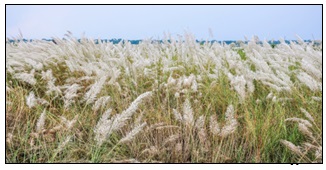
FIG. 1: SACCHARUM SPONTANEUM LINN.13
Geographical Distribution: Saccharum spontaneum, native to the tropical and subtropical regions of the Old World, spans parts of Africa, Southern Europe, the Middle East, and Asia up to Northern Australia. Believed to have evolved in India's sub-Himalayan valleys, it exhibits remarkable ecological adaptability, thriving in moist habitats like riverbanks and marshes but also tolerating drier conditions in grasslands and deserts. This resilience enables it to colonize various soil types, including infertile alluvial and saline soils 14.
In certain areas, it is classified as an aggressive weed or invasive species due to the same persistence and quick, strong growth that make it a significant medical resource. It has expanded widely, outcompeting native flora and creating thick, pure stands in places like the Panama Canal Watershed, especially in regions that have been cleared by floods or human activity. This dual character as an ecological challenge and a medicinal herb offers a special chance. Its rapid growth, low nutritional requirements, and high biomass production the very traits that characterize its invasiveness also make it a very sustainable and accessible raw material source. A bio-economic strategy, in which this invasive biomass is methodically and sustainably gathered for the manufacturing of phytopharmaceuticals, might be used in place of expensive eradication procedures. In line with contemporary ideas of sustainable development and ethnopharmacology, this would turn an ecological issue into a useful resource for healing 15.
Phytochemistry: Secondary metabolites found in Saccharum spontaneum root extracts can be discovered by phytochemical analysis of various extracts, showing the plant's phytochemical content. The S. root extract. Strong antioxidant and free radical scavenging properties are displayed by spontaneum. Numerous phytoconstituents, including glycosides, phenolic components, alkaloids, flavonoids, tannins, steroids, and terpenoids, may be responsible for this. The results of the study suggest that S. spontaneum root may be a useful natural antioxidant source that might be employed as a medicinal agent to prolong life, prevent disease, and maintain good health 16.
Quinones, terpenes, alkaloids, phenolic compounds, coumarins, saponins, tannins, steroids, proteins, and carbohydrates are some of the important phytoconstituents found in S. spontaneum leaves. This species' quick growth and low cost make it a suitable feedstock for the generation of fuel ethanol in the future. Its stem's high carbohydrate content (67.9% by weight) indicates that it is suitable for ethanol bioconversion, mainly through cellulose and hemicellulose. Investigating new lignocellulosic biomass (LB) feed stocks has become common procedure as biomass energy becomes more significant. Often referred to as wild sugarcane, kans, or sarkanda, S. spontaneum is a perennial rhizomatous grass belonging to the Poaceaceae family that has the capacity to produce ethanol 17.
It generates about 80 tons of biomass per hectare in tropical locations, such as Pakistan, Bangladesh, India, Nepal, and Sri Lanka. It grows on marginal ground and requires less water, while being less important commercially. It is a feasible renewable feedstock for ethanol-biofuel due to its 70% carbohydrate content, lignin (26%), extractives (6.14%), and ash (3.3%). The specific application of Ionic Liquids (ILs) in combination with surfactants for SSB pretreatment has not yet been investigated, despite research on the bioconversion of sodium bromide utilizing a variety of pretreatments 18, 19.
TABLE 2: LIST OF SECONDARY METABOLITES IN SACCHARUM SPONTANEUM LINN. 20-22
| Secondary Metabolite | Plant Part | Therapeutics Activity |
| Quinones | Leaves, Stem | Antimicrobial, Laxative |
| Phenolic Compounds | Roots, Leaves | Antioxidant, Anti-inflammatory, Antimicrobial |
| Terpenes | Roots, Leaves | Anti-inflammatory, Antimicrobial, Cytotoxic |
| Coumarins | Roots, Leaves, Stem | Anti-inflammatory, Anticoagulant, Antimicrobial |
| Steroids | Roots, Leaves, Stem | Anti-inflammatory, Hormonal activity |
| Alkaloids | Roots, Leaves, Stem | CNS active, Analgesic, Antimicrobial |
| Saponins | Roots, Leaves | Anti-inflammatory, Immunomodulatory, Hypocholesterolemic |
| Glycosides | Roots, Stem | Cardiotonic, Diuretic, CNS active |
| Essential Oils | Roots | Aromatic, Antimicrobial |
Traditional Application: The term "ethnobotany" refers to the study of local populations' interactions with their surroundings with the goal of recording customary plant uses that represent cultural knowledge. In order to incorporate traditional knowledge into resource management and promote biodiversity and cultural respect, ethnobotanical studies place a high priority on working with local communities. One important plant in this regard is S. spontaneum, which is used in traditional Indian medicine and is particularly well-known for its root qualities, which include diuretic and purgative actions. Its leaves are used to make a variety of goods, and its shoots are used for food in the Philippines and Indonesia, according to local customs. The plant's economic significance and multipurpose use are further demonstrated by the fact that it is an important resource for papermaking and animal feed 23, 24.
S. spontaneum has long been used for a variety of therapeutic uses by tribal communities in Andhra Pradesh and Tamil Nadu. The stems of the plant are used to treat ailments like hemorrhoids, menorrhagia, dysentery, and mental disorders. The roots work as a galactagogue and diuretic to treat UTIs. The plant's leaves are known for its cathartic and diuretic qualities, and its aerial portions exhibit laxative and aphrodisiac qualities. In Ayurvedic and Siddha traditions, the entire herb is used to cure obesity, gynecological problems, and stomach illnesses because to its purgative, tonic, and astringent properties 25, 26.
Applying leaf paste to injuries to stop pus from forming, using stem juice to cure mental diseases, and chewing fresh stems to relieve stomach-aches are some of the specific uses that have been suggested. Because of the plant's many uses, its fibers are often weaved into everyday objects like grain containers and carpets. Studies on the plant's effectiveness as a diuretic and for gastrointestinal and gynecological problems have been prompted by reports highlighting the community's trust in the plant's positive effects. As a result, S. spontaneum is acknowledged for its wide range of therapeutic uses among indigenous communities, helping to treat a variety of illnesses and fulfilling useful purposes in day-to-day living.
TABLE 3: TRADITIONAL USES OF DIFFERENT PLANT PARTS OF SACCHARUM SPONTANEUM L.
| Plant part | Uses |
| Aerial parts | Anemia, dyspnea, vomiting, mental illnesses, stomachproblems, and fatness 27 |
| Leaves | Building ropes, baskets, mats, brooms, and houses. Camelsand goats' food. Pulllas (a traditional mat) and brooms 28 |
| Roots | Used for galactagogue, and diuretic urinary tract infections 29 |
| Culm | A reliable source of pulp for making various grades of paper,particularly greaseproof paper 28 |
| Whole Plant | Contain carbohydrates, an appropriate substrate for thesynthesis of ethanol 29 |
Pharmacological Activities:
Anti-urolithiasis Activity: In line with its Ayurvedic classification as a Mutravirechaniya (diuretic) herb, specifically recommended for Ashmari (renal calculi), S. spontaneum's medicinal action is clearly validated for its effects on the urinary system. The ethanolic root extract of Kasha demonstrated notable anti-urolithiatic effects at doses of 200 and 300 mg/kg in meticulously carried out in-vivo investigations, especially in rat models of induced urolithiasis.
In addition to regulating important lysosomal enzymes like xanthine oxidase and β-D-glucuronidase that contribute to stone etiology, the extract successfully restored aberrant levels of urinary stone-forming ingredients such calcium, oxalate, urea, and uric acid.
Its effectiveness was comparable to that of thiazide, a common diuretic and anti-urolithiatic medication, demonstrating its promise for kidney stone treatment and prevention. According to the research, the word Ashmarihara (stone remover) refers to both specific impacts on stone formation mechanisms and enhanced urine flow, supporting ancient Ayurvedic assertions. The extract's historical effectiveness in treating Ashmari is confirmed by its capacity to regulate hyperoxaluria and hypercalciuria, the biochemical indicators that cause crystal formation 30, 31.
Anti-oxidant Activity: Numerous in-vitro investigations show that S is capable of scavenging free radical S. spontaneum extracts using phosphomolybdenum, FRAP (Ferric Reducing Antioxidant Power), and DPPH (2,2-diphenyl-1-picrylhydrazyl) tests. Root and whole plant ethanolic extracts have moderate to significant antioxidant effects; one study found that the overall antioxidant activity was 488 µg/ml, which is similar to ascorbic acid's 410 µg/ml. Due to the high concentrations of phenolic and flavonoid chemicals in the extracts, a recent methanolic extract of the flowers also shown potent antioxidant activity 32.
Anti-inflammatory Activity: It has been shown to have anti-inflammatory properties in-vivo. A significant study assessed a cream made with 0.5% to 2% ethanolic root extract in a mouse model of paw edema caused by carrageenan. The outcomes were striking: the 2% extract cream significantly reduced inflammation, and after three hours of application, its efficacy outperformed that of Diclofenac 1% gel, a common anti-inflammatory medication. Another study found that Saccharummunja, a similar species, had mild anti-inflammatory properties againstedema caused by carrageenin 5.
Anti-microbial Activity: Herbs are commonly used in traditional medical systems to cure illnesses; studies have shown that S. spontaneum has broad-spectrum antibacterial qualities. Significant antibacterial activities against a variety of human pathogenic bacteria were found in an in vitro investigation of a methanolic extract from the entire plant. Gram-positive strains like Staphylococcus aureus (17.00 mm) and Streptococcus pneumoniae (16.50 mm) as well as Gram-negative germs like Escherichia coli (18.00 mm) and Klebsiella pneumoniae (17.10 mm) showed significant zones of inhibition against the extract. For both Gram-positive and Gram-negative bacteria, the minimum inhibitory concentration (MIC) varied between 75 and 300 µg/ml and 75 and 600 µg/ml, respectively. Phytochemicals like tannins and flavonoids, which can interfere with vital bacterial functions including cell wall and protein synthesis, are responsible for this antibacterial effect. Furthermore, leaf extracts based on ethanol shown antibacterial efficacy against Bacillus subtilis 33, 34.
CNS Depressant Activity: In a study on rats, Vhuiyan et al. evaluated the effects of aqueous, ethanolic, and chloroform extracts on locomotor activity at a dosage of 1000 mg/kg (p.o.). They discovered that all extracts reduced movement, suggesting a central nervous system (CNS) depressive action. Furthermore, a different study shown that methanol extract dramatically reduced locomotor activity in both hole cross and open field tests, with a higher CNS depressive effect seen at a dose of 400 mg/kg as opposed to 200 mg/kg 35.
Safety and Toxicology: When assessing the therapeutic index of novel medications or herbal extracts, preclinical safety evaluations are crucial. Studies on S. spontaneum's ethanolic root extract show a large safety margin. Over the course of a 14-day observation period, increasing doses up to 2000 mg/kg were given to Wistar albino rats in an acute toxicity trial without any mortality or toxicity indications. This suggests that the median lethal dose surpasses 2000 mg/kg, classifying it as practically non-toxic.
Furthermore, a 28-day sub-acute toxicity study at dosages between 100 and 500 mg/kg showed no negative effects on body weight or notable changes in biochemical parameters linked to electrolytes and kidney function, indicating that long-term administration at therapeutic levels carries little risk of organ damage or systemic toxicity. In line with the plant's traditional use, where poisonous plants would have been recognized and avoided over generations, this strong preclinical safety profile provides the scientific foundation for moving on to human clinical trials 36.
CONCLUSION: Saccharum spontaneum, sometimes referred to as wasteland weed or wild sugarcane, is a multipurpose plant with many traditional therapeutic uses, especially in South Asia, and a rich phytochemistry. Because of its many medicinal qualities, which include antioxidant, antiurolithiasis, anti-obesity, CNS depressant, antibacterial, antifungal, cytotoxic, anti-inflammatory, anti-diarrheal, and hypolipidemic effects, it treats a wide range of illnesses, including gastrointestinal and mental health disorders. Its phytoconstituents alkaloids, flavonoids, tannins, and terpenoids are responsible for these advantages. Furthermore, S. spontaneum is a viable sustainable biomass feedstock for fuel ethanol production due to its high carbohydrate content and quick growth. Beyond the medical field, it is used in businesses such as mulching, papermaking, and rope and mat manufacturing. Its promise as a therapeutic agent is supported by safety assessments that show low toxicity.
ACKNOWLEDGEMENT: Nil
CONFLICT OF INTEREST: Nil
REFERENCES:
- Parrotta JA: Healing plants of peninsular India 2001.
- Devi P and Kameswari B: Pharmacognostic and Preliminary Phytochemical Investigations on the stem of Saccharum spontaneum. Screening 19(20): 21-2.
- Xu F, He L, Gao S, Su Y, Li F and Xu L: Comparative analysis of two sugarcane ancestors Saccharum officinarum and spontaneum based on complete chloroplast genome sequences and photosynthetic ability in cold stress. Inter J of Mol Sciences 2019; 20(15): 3828.
- Govindaraj P, Karthigeyan S and Pazhany AS: Exploration and genetic diversity analysis of Saccharum spontaneum in Maharashtra state. India 2016.
- Lapuz AM, Arabiran RD, Sembrano TM, Albaniel JR, Paet JC and Maini HA: Preformulation and evaluation of antibacterial and anti-inflammatory activities of Saccharums pontaneum linne root extract cream 2015.
- Chandel AK, Narasu ML, Chandrasekhar G, Manikyam A and Rao LV: Use of Saccharum spontaneum (wild sugarcane) as biomaterial for cell immobilization and modulated ethanol production by thermotolerant Saccharomyces cerevisiae Bioresource Technology 2009; 100(8): 2404-10.
- Meng Z, Han J, Lin Y, Zhao Y, Lin Q, Ma X, Wang J, Zhang M, Zhang L, Yang Q and Wang K: Characterization of a Saccharum spontaneum with a basic chromosome number of x= 10 provides new insights on genome evolution in genus Saccharum. Theoretical and Applied Genetics 2020; 133(1): 187-99.
- Mary S, Nair NV, Chaturvedi PK and Selvi A: Analysis of genetic diversity among Saccharum spontaneum from four geographical regions of India, using molecular markers. Genetic Resources and Crop Evolution 2006; 53(6): 1221-31.
- Saccharum spontaneum. Federal Noxious Weed Disseminules of the U.S. [Internet]. 2018. Available from:https://idtools.org/fnwd/index.cfm?packageID=1097&entityID=2676
- United States Department of Agriculture (USDA), Animal and Plant Health Inspection Service (APHIS). Weed Risk Assessment for Saccharum spontaneum (Poaceae) – Wild sugarcane. [Internet]. 2016. Available from:https://www.aphis.usda.gov/plant_health/plant_pest_info/weeds/downloads/wra/Saccharum_spontaneum_WRA.pdf
- Royal Botanic Gardens, Kew. Saccharum spontaneum Plants of the World Online. [Internet]. 2024 [cited 2024 Jan 14]. Available from:https://powo.science.kew.org/taxon/urn:lsid:ipni.org:names:420031-1
- Khalid M and Siddiqui HH: Pharmacognostical evaluation and qualitative analysis of Saccharum spontaneum root. International Journal of Pharmaceutical Sciences and Drug Research 2011; 3(4): 338-341.
- Photo: Joydeep / Wikimedia Commons / CC BY-SA 3.0. https://commons.wikimedia.org/wiki/File:Saccharum_spontaneum_at_the_bank_of_rever_Ganges_07102013_01.jpg
- Vhuiyan M, Ripa FA and Mamun M: CNS depressant activity of the crude extracts of Saccharum spontaneum. Bangladesh Journal of Pharmacology 2008; 3(2): 65-68.
- Paulraj CS, Subbaraj GK, Arifunhera J, Annadurai DP, Sundaram K and Isaac JB: Evaluating the Antioxidant and Anticancer Activity of Saccharum spontaneum Linn Flower Extract in Hepatocellular Carcinoma: An in-vitro and in-vivo Journal of Natural Remedies 2024; 24(11): 2493-2503.
- Fatima I, Kanwal S and Mahmood T: Evaluation of biological potential of selected species of family Poaceae from Bahawalpur, Pakistan. BMC Complementary and Alternative Medicine 2018; 18(1): 27.
- Scordia D, Cosentino SL and Jeffries TW: Second generation bioethanol production from Saccharum spontaneum ssp. aegyptiacum (Willd.) Hack. Bioresource Technology 2010; 101(14): 5358-65.
- Pandey VC, Bajpai O, Pandey DN and Singh N: Saccharum spontaneum: an underutilized tall grass for revegetation and restoration programs. Genetic Resources and Crop Evolution 2015; 62(3): 443-50.
- Baruah J: An Integrated Approach for Generation of Hydroxymethylfurfural Platform Chemical from Renewable Lignocellulosic Sources (Doctoral dissertation, Tezpur University) 2023.
- Chandel AK, Narasu ML, Chandrasekhar G, Manikyam A and Rao LV: Use of Saccharum spontaneum (wild sugarcane) as biomaterial for cell immobilization and modulated ethanol production by thermotolerant Saccharomyces cerevisiae Bioresource Technology 2009; 100(8): 2404-10.
- Komathi V and Durai P: A study on phytochemical screening and in-vitro antioxidant activity of ethanolic extract of Saccharums pontaneum. International Journal of Chemico-Pharmaceutical Sciences 2015; 5(2): 18-22.
- Musaddique M, Husnain S, Shahzad M and Chaudhary M: Assessment of antibacterial potential of Saccharum spontaneum Linn (family: Poaceae) against different pathogenic microbes- an in-vitro Journal of Applied Pharmaceutical Science 2014; 4(7): 085-089.
- Eldeen IM, Effendy MA and Tengku-Muhammad TS: Ethnobotany: Challenges and future perspectives. Research Journal of Medicinal Plants 2016; 10(6-7): 382-7.
- Mohammad Khalid MK and Siddiqui HH: Pharmacognostical evaluation and qualitative analysis of Saccharum spontaneum (L.) Root 2011.
- Devi JAI and Muthu AK: Evaluation of hypolipidemic activity of ethanolic extract from whole plant of Saccharum spontaneum in rat fed with atherogenic diet. Pharm Lett 2015; 7: 103-109.
- Bhatta M, Joshi R and Sapkota RP: Assessment of forest fire and its impact on plant biodiversity of buffer zone, Langtang National Park, Nepal. Indonesian Journal of Social and Environmental Issues (IJSEI) 2022; 3(3): 241-51.
- Rajkumar A, Ramya J and Saraswathi K: Antioxidant activities and total flavonoids content of various extracts from aerial parts of Saccharum spontaneum (Linn.).
- Shaheen H, Qureshi R, Qaseem MF and Bruschi P: The fodder grass resources for ruminants: A indigenous treasure of local communities of Thal desert Punjab, Pakistan. PloS one 2020; 15(3): 0224061.
- Padalia H and Chanda S: Comparative phytochemical analysis of aerial parts of procumbeans, F. dichotoma, S. sponteneum, S. nigra and T. angustifolia. Journal of Pharmacognosy and Phytochemistry 2015; 4(2).
- Sharma P and Patel M: Comprehensive Documentation and Critics on Trinapanchamula. Ayushdhara 2019; 6(6): 2345-2350.
- Sathya M and Kokilavani R: Effect of Saccharum spontaneum on Lysosomal enzymes of Uro-lithiatic rats. J of Applied Pharmaceutical Scie 2012; 2(9): 122-6.
- Sathya M and Kokilavani R: Phytochemical screening and in-vitro antioxidant activity of Saccharumspontaneum Linn. Int J Pharm Sci Rev Res 2013; 18(1): 75-9.
- Cagampan NFL, Caguiat GM, Cajayon ANB, Calabinhi AZS, Calangi JFG and Calimbahin MC: Antimicrobial effect of ethanol-based leaf extract of Saccharum spontaneum (Talahib) against Bacillus subtilis: an experimental study. De La Salle Medical and Health Sciences Institute 2017.
- Rahman S and Singh S: A review on some medicinal grasses from Ayurveda. World Journal of Pharmaceutical Research 2022; 11(8): 1234-1245.
- Vhuiyan MM, Biva IJ, Saha MR and Islam MS: Anti-diarrhoeal and CNS Depressant Activity of Methanolic Extract of Saccharum spontaneum Stamford Journal of Pharmaceutical Sciences 2008; 1(1): 63-8.
- Khalid S and Siddiqui HH: Free radical scavenging and total phenolic content of four Indian medicinal plants. International Journal of Pharmaceutical Sciences and Research 2011; 2(7): 1786-1790.
How to cite this article:
Deepika SV, Ruth V, Adithya V, Srimathi V, Padma R and Sathish A: A comprehensive review on the therapeutic potential of wild sugarcane (Saccharum spontaneum Linn.). Int J Pharmacognosy 2026; 13(4): 270-76. doi link: http://dx.doi.org/10.13040/IJPSR.0975-8232.IJP.13(4).270-76.
This Journal licensed under a Creative Commons Attribution-Non-commercial-Share Alike 3.0 Unported License.
Article Information
6
270-276
812 KB
201
English
IJP
Shanmuga V. Deepika *, V. Ruth, V. Adithya, V. Srimathi, R. Padma and A. Sathish
GRD College of Pharmacy, Thiruvallur, The Tamil Nadu Dr. M.G.R Medical University, Chennai, Tamil Nadu, India.
deepikadeepikad018@gmail.com
28 March 2026
11 April 2026
18 April 2026
10.13040/IJPSR.0975-8232.IJP.13(4).270-76
30 April 2026
 Download